Built So Employees Want to
Use It — Not Because They're
Told To
People adopt what benefits them directly — not eventually, but within minutes.

You Already Know How This Usually Ends
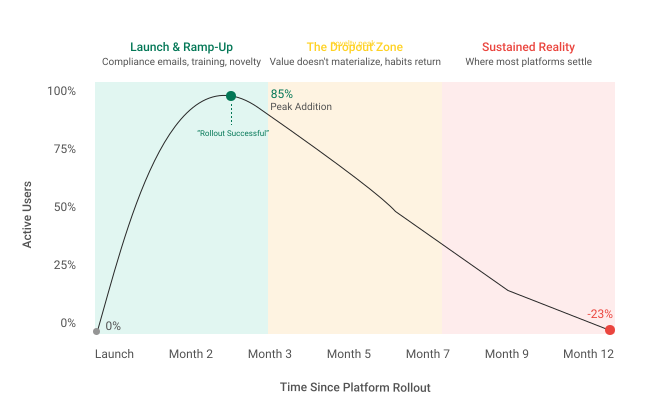
Eighteen months in. The dashboard shows 14% active users. Leadership keeps asking why.
Nobody has a good answer.
The rollout went fine. Training happened. Emails were sent. And then — slowly — people stopped logging in.
This pattern repeats across the industry. The average enterprise HR tool holds just 23% sustained adoption after year one.
Why It Keeps Happening
Most platforms assume people will use a tool because they are told to. They will not. Not at scale. Not sustainably.
Mandates create compliance. Gamification creates short-term spikes. Neither builds habit. The platforms that survive share one trait: immediate, personal value.

Mandate
THE ASSUMPTION
"If we require it, they'll use it."
WHAT IT CREATES
Compliance
People log in because they have to — not because they want to.
THE USER MINDSET
"I have to do this."
WHAT HAPPENS
Usage decays the moment oversight lifts. Minimum viable engagement becomes the norm.


Motivation
THE ASSUMPTION
"If we train and excite them, they'll adopt it."
WHAT IT CREATES
Short-term spike
Novelty drives exploration. Training creates initial engagement.
THE USER MINDSET
"I want to try this."
WHAT HAPPENS
Excitement fades. Without ongoing value, users drift back to old habits.


Value
THE REALITY
"If it solves my problem today, I'll come back tomorrow."
WHAT IT CREATES
Habit
Immediate personal value turns usage into routine.
THE USER MINDSET
"I need this."
WHAT HAPPENS
Usage sustains because the platform earns attention every time it's opened.

What We Built Differently
SynapseScope was designed around one premise: people adopt what benefits them directly — not eventually, but within minutes.
Leadership Assessment
6 Minutes to Insight
An employee finishes the assessment during a coffee break. Immediately, they see their leadership profile—persona, communication style, natural strengths, blind spots.
No psychologist. No debrief. No waiting.
What makes it stick: practical guidance for working with people who think differently.
Take AssessmentSkill Profile
The profile is live.
Now they see which internal roles fit their capabilities. Which career paths are opening. Where gaps exist.
Most enterprise skill platforms require 30+ minutes of manual input. Lengthy onboarding is the primary driver of abandonment.
Extract SkillsWhy It Stays Adopted
Initial value gets people in. Sustained value keeps them.
Adoption sticks when every stakeholder gets ongoing value—not just at launch.
| Ongoing Value | Employee | Manager | L&D / CHRO |
|---|---|---|---|
| Visibility for internal opportunities | - | - | |
| Find peers learning the same skills | - | - | |
| See skill gaps for target roles | - | - | |
| View team skill coverage | - | - | |
| Identify succession readiness | - | - | |
| Set and track upskilling KPIs | - | - | |
| Access training budget with evidence | - | - | |
| Measure training ROI | - | - | |
| Spot skill obsolescence risk | - | - | |
| Org-wide skill inventory | - | - | |
| On-the-job learning visibility | - | - |
| Ongoing Value | Employee | Manager | L&D / CHRO |
|---|---|---|---|
| Know your leadership persona and style | - | - | |
| Understand your communication preferences | - | - | |
| Guidance for working with different styles | - | - | |
| See team balance (strategy / people / execution) | - | - | |
| Development tips for each direct report | - | - | |
| Identify collaboration friction points | - | - | |
| Target leadership development programs | - | - | |
| Succession planning by leadership profile | - | - | |
| Team composition analysis at scale | - | - | |
| Cognitive diversity view across organization | - | - | |
| Identify organizational blind spots | - | - |
Teams Form in Seconds
Teams are created from simple invite-based setup—no configuration project.
Teams are created from simple invite-based setup—no configuration project.
Instantly visible: where each person sits on the leadership ternary plot. It shows, at a glance, whether a team skews toward strategy, people, or execution—and where balance is missing.
Managers get development tips for each direct report. Colleagues see how to communicate across styles.
This is not a PDF that gets filed away. It is a working tool.
Learn more
Questions Serious Buyers Ask
On adoption
On stakeholder value
On rollout
On privacy and control
On ongoing management
Ready to See How This Works?
If you are evaluating platforms, we would rather show you than pitch you.