

This page is about the Stability Guardian: the leader whose risk-aversion and process discipline preserve organizational value when others chase opportunity into preventable damage. See all 20 personas →
About SynapseScope's framework
SynapseScope's leadership personas are proprietary behavioral archetypes, grounded in behavioral psychology and validated against assessment data from thousands of leaders. The framework identifies 20 distinct archetypes. Each one names the pattern that emerges when behavioral tendencies across eight dimensions combine into a recognizable leadership signature.
When Boeing rushed the 737 MAX to compete with Airbus, engineers raised concerns about safety systems. Flight characteristics had changed. Pilots needed more training. The MCAS software needed redundancy. But there was pressure to move fast, cut costs, certify quickly. Those concerns were dismissed as resistance to innovation.
346 people died in two crashes[1]. The aircraft was grounded worldwide for 20 months, and Boeing's own filings put direct MAX-related costs above $20 billion[10]. The root cause traced back decades, to a cultural shift that prioritized cost and speed over safety and over the cautious voices asking uncomfortable questions about what could go wrong[2].
These are Stability Guardians: leaders who ask what could go wrong before others ask what's possible, and who favor tested approaches and process discipline as a way to keep reliability non-negotiable. Across the leaders SynapseScope has assessed through December 2025 (a sample skewed toward mid-to-senior corporate roles), Stability Guardians are roughly 5-7% of the cohort[†]. Their presence reduces the odds of catastrophic failure when leadership actually weighs their concerns against speed-to-market pressure.
The Psychological Profile of a Stability Guardian
Stability Guardians tend to be undervalued in innovation-obsessed cultures. If you're one, you've watched a careful risk assessment get filed under "being negative" while a bolder peer's untested proposal got the budget. The cost of that mislabeling shows up later, in the failures the assessment would have caught.
Behaviorally, the profile clusters around four tendencies that travel together:
- Risk aversion shows up as cautious decision-making and a strong pull toward security over speculative upside[3].
- Conservative orientation means trusting tested approaches, with consistency and quality as the working defaults.
- Reliability shows up as dependable delivery and standards held in place even when flexibility would be easier.
- Process-centric focus keeps operational consistency intact, so colleagues can plan around the work.
The combination produces a specific behavior: change isn't reflexively resisted, but it has to clear an honest assessment of what could go wrong before commitment, and proven approaches aren't given up for untested alternatives unless the evidence demands it. The difference between a Stability Guardian and a rigid traditionalist is that the Stability Guardian's caution is selective: risks are weighed, not refused, and the processes preserved are the ones still earning their keep.
Aon's Risk Maturity Index, run with Wharton, reported that firms with more mature risk-management practices showed greater stock-price resilience and stronger return-on-equity than firms in the lowest maturity quartile[7]. Other work on risk management argues that, under the right governance conditions, careful assessment translates into a durable advantage rather than just a brake on speed[5][6].
Why Every Leadership Team Needs This Perspective
Stability Guardians keep companies out of the failure modes that follow unchecked optimism: missed risks, abandoned controls, untested replacements for working systems. The lesson Boeing's MAX program forced into the open is that some risks shouldn't be taken, some changes destroy value, and some proven approaches outlive every replacement pitched against them.
The Unique Value You Bring
When others pursue bold moves, you assess what could go wrong.
In drug development, the discipline shows up as the willingness to keep a candidate in Phase III trials when commercial pressure wants it released. The cost of holding the line is delayed revenue. The cost of letting it slip is a Vioxx-scale withdrawal[11]. Stability Guardians are the leaders who price those costs honestly against each other rather than against the quarterly forecast.
When others abandon proven approaches, you maintain what works.
Toyota's quality reputation didn't come from constant innovation. It came from leaders who refined and protected kaizen and the Toyota Production System rather than swap them out for whatever was newer[8]. Reliability, not novelty, was Toyota's edge.
When others see constraints as obstacles, you see them as protections.
Risk management compounds into competitive advantage when boards reward avoided losses, not only realized gains[9]. Regulations, processes, and proven approaches exist because someone earlier paid the price of learning. The work of a Stability Guardian is to keep those lessons in force when the room would rather treat them as bureaucracy.
Situations Where Stability Guardians Become Indispensable
1. High-Stakes Industries Requiring Safety and Compliance
In industries where failure is catastrophic (aviation, healthcare, nuclear power, financial services), Stability Guardians keep safety standards above the regulatory floor rather than at it. The work is redundant systems, rigorous protocols, and a refusal to let proven controls erode under cost pressure.
Real impact: The U.S. commercial nuclear fleet logged a median capacity factor near 90% in recent years, driven by exactly this kind of redundancy and protocol discipline rather than by clever shortcuts[12].
2. Financial Risk Management and Compliance
In financial services, the work is the same logic applied to credit risk, regulatory compliance, and balance-sheet exposure: holding underwriting standards in place when growth targets argue for relaxing them.
Consider this: Through 2008, banks that came out of the crisis with the strongest balance sheets tended to be the ones that had kept conservative lending standards and rigorous underwriting in force during the boom years. What read as "slow" while the market was running provided the balance sheet that survived the unwind.
3. Operational Excellence Through Process Discipline
When the work calls for consistent quality and reliability, Stability Guardians hold the process discipline in place that turns proven methods into predictable output.
Real impact: Toyota's andon-cord protocol, where any line worker can halt production on a defect, only delivers quality because the leaders running the plant treat the stop as data rather than as a problem to manage around[8]. The control is the discipline of honoring it.
4. Organizational Transitions Requiring Stability
During mergers, leadership changes, and market shocks, Stability Guardians keep core operations running so the rest of the leadership team has a stable platform to drive change from.
In the M&A transitions SynapseScope has had visibility into, operational continuity tends to track whoever owns process discipline through the handover. The visionaries set the direction; the Stability Guardian keeps customers served and regulators satisfied while the new structure takes hold.
When This Persona Goes Wrong
The same disposition that prevents disasters can, left unchecked, walk an organization into obsolescence. Without counterweight from Innovative Change-Makers, Visionary Innovators, or Adaptive Achievers, the risk assessment that protects value starts to filter out opportunities that needed to be taken on imperfect information. Caution stops being a tool and starts being the default answer.
The failure mode looks like this: every proposal gets a thorough downside review, every proven approach stays in place past its useful life, and the organization slowly stops moving even as the market keeps shifting. Sometimes the right answer isn't more analysis. It's accepting uncertainty and committing on the evidence available.
The harder failure is structural. If a Stability Guardian can't share decision rights with leaders who carry the innovation and adaptation load, the protective instinct expands to cover risks that should have been taken and processes that should have evolved a year ago.
If your reaction to this section is "but these risks ARE real, the others just don't take them seriously," that reaction is itself the diagnostic. The Stability Guardians who stay effective hold a clear line between the risks that genuinely warrant protection and the ones where additional analysis is just a way to defer commitment.
Creating Collaboration, Not Clash
Most of the friction around a Stability Guardian comes from misallocated decision rights, not personality. Four pairings show what the role looks like when the rights are clear:
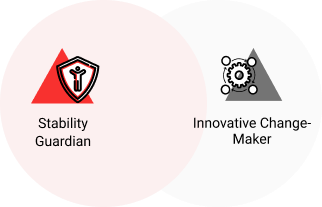
Stability Guardian + Innovative Change-Maker. The pairing works when the Change-Maker brings concrete proposals and the Guardian's assessment becomes the gate that strengthens them rather than the wall that blocks them. It breaks when the Guardian's veto is unilateral or the Change-Maker treats assessment as friction to be routed around.
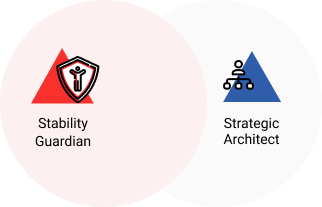
Stability Guardian + Strategic Architect. Long-horizon vision paired with continuity discipline: the Architect maps where the organization is heading, and the Guardian identifies which capabilities have to stay intact through the transition for the destination to be reachable.
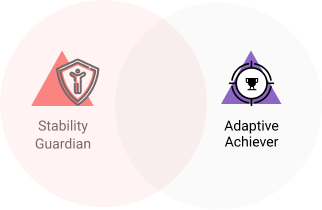
Stability Guardian + Adaptive Achiever. The Achiever brings the flexibility to respond fast; the Guardian brings the perspective on which controls have to survive the pivot for the response to be safe. Together they produce adaptation that doesn't quietly erode the foundation.
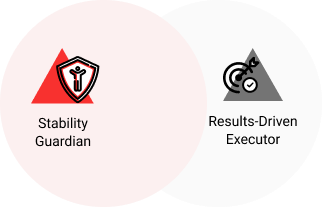
Stability Guardian + Results-Driven Executor. Execution speed paired with downside discipline. The Executor closes the work; the Guardian flags where speed is about to compound a real risk rather than an imagined one.
When teams agree on which persona owns which decision, differences stop becoming turf fights. The risk assessment and stability protection a Guardian provides give the rest of the team room to push for innovation and growth without unwittingly trading the foundation away.
In closing
The Stability Guardian isn't a leadership style to celebrate or correct. It's one of 20 patterns SynapseScope models. The fit between the pattern and the role — and the operators around the leader — determines whether the value compounds or the team burns out. Read about all 20 personas →
References & Sources
- Kitroeff, N., Gelles, D., & Nicas, J. (2019). What Really Brought Down the Boeing 737 Max? The New York Times Magazine. Cited for: Boeing 737 MAX crashes, MCAS system failures, and 346 deaths.
- George, B. (2024). Why Boeing's Problems with the 737 MAX Began More Than 25 Years Ago. Harvard Business School Working Knowledge. Cited for: Boeing's cultural shift from engineering excellence to cost-cutting over 25+ years.
- † SynapseScope Leadership Database (December 2025). Proprietary assessment data. For methodology, see Spectrum Foundation Research.
- Choma, B. L., Hanoch, Y., Hodson, G., & Gummerum, M. (2014). Risk propensity among liberals and conservatives: The effect of risk perception, expected benefits, and risk domain. Social Psychological and Personality Science, 5(6), 713-721. Cited for: Research on risk aversion traits and conservative decision-making patterns in business contexts.
- Elahi, E. (2013). Risk management: The next source of competitive advantage. Foresight, 15(2), 117-131. DOI Link Cited for: How effective risk management creates competitive advantage.
- Artinger, F. M., Marx-Fleck, S., Junker, N. M., Gigerenzer, G., Artinger, S., & van Dick, R. (2025). Coping with uncertainty: The interaction of psychological safety and authentic leadership in their effects on defensive decision making. Journal of Business Research, 190, 115240. DOI Link Cited for: How psychological safety and authentic leadership reduce defensive decision-making under uncertainty.
- Aon Risk Solutions. (2012). Risk Maturity Index: Correlation between mature risk management and financial results. Partnership with Wharton School. Cited for: Firms with more mature risk-management practices showed greater stock-price resilience and stronger ROE than less-mature peers.
- Liker, J. K. (2004). The Toyota Way: 14 Management Principles from the World's Greatest Manufacturer. McGraw-Hill. Cited for: Toyota Production System (TPS), kaizen, and process stability as competitive moat.
- Li, Y., Rajgopal, S., Srinivasan, S., & Wong, L. (2025). How Banks Tightened Risk Controls After the 2008 Crisis. Harvard Business School Working Knowledge. Cited for: Post-2008 board-level risk-control mechanisms in U.S. banks; risk management compounding into competitive advantage when boards reward avoided losses.
- Federal Aviation Administration. (2020, November 18). Boeing 737 MAX groundings: FAA rescinds grounding order after 20-month worldwide grounding (March 13, 2019 – November 18, 2020). Cited for: 20-month duration of the worldwide 737 MAX grounding and the approximately $20 billion direct-cost figure attributable to MAX-related charges in Boeing's filings.
- Topol, E. J. (2004). Failing the Public Health — Rofecoxib, Merck, and the FDA. New England Journal of Medicine, 351(17), 1707-1709. Cited for: Merck's September 30, 2004 Vioxx (rofecoxib) withdrawal as a benchmark for the scale of post-approval drug-safety failures.
- U.S. Energy Information Administration. (2025). U.S. nuclear industry: average annual capacity factor. Cited for: U.S. commercial nuclear fleet capacity factor near 90% in recent years (EIA reports a 91% average annual capacity factor for nuclear power plants in 2025).
Assessment Methodology
SynapseScope Leadership Assessment measures behavioral patterns across 8 dimensions using validated psychometric principles. Prevalence statistics derived from proprietary leadership database (December 2025). For technical documentation on the Spectrum Foundation framework, see Spectrum Foundation Research.
Discover Your Leadership Persona
Where do you fit in your organization's leadership ecosystem?