

This page is about the Strategic Architect: the leader who connects long-term vision with anticipatory foresight through carefully planned execution. See all 20 personas →
About SynapseScope's framework
SynapseScope's leadership personas are proprietary behavioral archetypes, grounded in behavioral psychology and validated against assessment data from thousands of leaders. The framework identifies 20 distinct archetypes. Each one names the pattern that emerges when behavioral tendencies across eight dimensions combine into a recognizable leadership signature.
When Netflix launched streaming in 2007, DVDs still generated 100% of their revenue. Wall Street analysts told Reed Hastings to choose: protect the profitable DVD business or cannibalize it for unproven streaming. Blockbuster faced the same choice and stayed with DVDs. They're gone[1]. Netflix had vision (streaming would dominate) and foresight (predicted broadband adoption curves). What made the difference was strategic architecture.
Hastings didn't abandon DVDs prematurely or cling to them too long. He designed a decade-long transition: stream while DVDs funded infrastructure, build the content library while predicting that licensing costs would explode, launch original content before the licenses expired. Each phase funded the next, cautious enough to manage existential risk while bold enough to transform the industry[1]. By 2013, DVD revenue was declining. Streaming dominated, and original content was launching[1].
The result: Netflix's market cap exceeded $300B by 2024, while Blockbuster filed for bankruptcy in 2010[1]. That outcome came from strategic architecture spanning time horizons, not from reckless pivots or cautious incrementalism.
These are Strategic Architects: leaders who design strategies connecting long-term vision with medium-term anticipation through carefully planned execution. They think in decades while planning in years. In SynapseScope's December 2025 assessment sample, roughly 5-7% of leaders fit this profile[2], and their presence separates organizations that navigate transformation from those that either miss it entirely or destroy value pursuing it recklessly.
The question: do you have someone who architects strategy across time horizons, and are you that person?
The Psychological Profile of a Strategic Architect
Strategic Architects sit between two camps. You produce more thorough plans than the visionaries and more imaginative ones than the analysts; you also produce them more slowly than either group, and your plans break when conditions shift faster than your scenario set anticipated.
From a behavioral psychology perspective, the cognitive profile combines:
- High Visionary Orientation (strategic imagination, long-term thinking, transformational vision)
- High Foresight Capability (anticipatory planning, trend detection, predictive analysis)
- Cautious Risk Management (careful assessment, thorough evaluation, stability preference)
What makes the combination psychologically distinct is the architectural move: imagining a future is not enough, predicting one is not enough, so you build pathways from today's constraints to the future state and design strategies that account for several plausible scenarios at once.
In a strategy session, while visionaries sketch transformational possibilities and analysts present predictive models, you are already building the strategic architecture: connecting long-term aspirations with medium-term forecasts, identifying decision points where the path may need to shift, and designing contingencies for predicted scenarios.
The difference between a Strategic Architect and an unhedged visionary is the foresight thread paired with risk awareness; an unhedged visionary commits to the future without designing for what could go wrong on the way there.
Research on leader cognition in real-world settings finds that strategic decision-making draws on creative, analytical, and executive-function processes together[3]. The same pattern shows up in how Strategic Architects work a problem.
Why Every Leadership Team Needs This Perspective
Imagine an architect who can only sketch inspiring renderings but never produces structural plans, or one who can only calculate load-bearing requirements without grasping the building's purpose. Either way, nothing gets built.
Most organizations operate with this split: visionaries who inspire without roadmaps, or planners who optimize without transformational direction. When the organization has both the patience for multi-year planning and the execution capacity to follow through, Strategic Architects deliver the capacity to design multi-year roadmaps that connect inspiring visions with anticipated realities.
The Unique Value You Bring
From possibility to pathway.
When Satya Nadella envisioned Microsoft's shift from desktop software to cloud-first, the multi-year roadmap was where the work happened: a cultural transformation timed against competitive moves, market shifts, and technology trends that would shape the journey[4].
From forecast to leverage.
As generative AI cost dynamics began evolving through 2023, the architect's instinct was to weave the change into the FY24 plan with procurement and pricing implications already mapped, not to wait for the trend to be confirmed and then react. Predictions become positioning.
From debate to bridge.
Ambitious imagination and realistic anticipation are not a choice; they are inputs to the same architecture, and the work is to make a plan that is both inspiring and executable.
Situations Where Strategic Architects Become Indispensable
1. Multi-Year Strategic Planning and Transformation
When organizations need to chart a course through significant transformation (digital shifts, market repositioning, business model evolution), Strategic Architects design the roadmap. The destination is not the deliverable; the journey is, with milestones, decision points, and contingencies built in.
Real impact: Adobe's transition from boxed software to cloud subscription unfolded across a multi-year roadmap that balanced the visionary goal of becoming a SaaS leader against anticipated customer resistance, revenue-model transitions, and competitive responses[5]. The roadmap, paired with sustained investor patience and a captive professional user base, turned a high-risk model shift into deliberate transformation.
2. Market Expansion and Growth Strategy
Organizations entering new markets or scaling existing ones need someone to balance growth ambitions with market realities. Expansion strategies imagine transformational scale while anticipating regulatory hurdles, cultural differences, and competitive dynamics, market by market.
Consider this: Airbnb's global expansion involved a market-by-market regulatory response that varied widely in outcome (the China entry and eventual exit, contrasting European cities that negotiated frameworks with those that imposed bans)[7]. Some entries succeeded; others did not. The architecture-style decisions show up in which markets earned a multi-year commitment and which were treated as optional.
3. Navigating Industry Disruption
When entire industries face technological or market disruption, Strategic Architects help organizations imagine their future role while anticipating the disruption's trajectory. The work is to position the organization to shape disruption rather than only respond to it.
Real impact: Volkswagen's ID. program and GM's Ultium platform are architecture-style EV transitions, mapping battery technology evolution, charging infrastructure development, and regulatory timelines into multi-year roadmaps[8]. The contrast with slower-moving incumbents now scrambling to catch up is the strategic-architecture dividend.
4. Mergers, Acquisitions, and Integration
M&A success requires someone who can imagine the synergistic future while anticipating integration challenges. Integration roadmaps balance transformational value creation against realistic cultural, operational, and systems challenges.
When Disney acquired Pixar in 2006, Bob Iger and Ed Catmull built an integration plan that preserved Pixar's innovation culture while leveraging Disney's distribution power[6]. That is strategic architecture in practice.
When This Persona Goes Wrong
The same architectural instinct that produces durable plans also produces predictable failure modes when it goes unchecked.
Without balance from other personas (Results-Driven Executors, Operational Executors, Adaptive Achievers), Strategic Architects can produce beautifully designed strategies that never translate into action. The five-year roadmap is built while the organization drowns in today's operational fires. Careful, thorough planning becomes analysis paralysis that delays decisions which can be made now and refined later.
The risk multiplies when caution turns into conservatism. Transformational futures get imagined but the pathways are so risk-averse that nothing actually transforms. So many scenarios get anticipated and so many contingencies get designed that the strategy becomes too complex to execute. Sometimes the answer is bold action with incomplete information, not another planning cycle.
A second failure mode is isolation. Without input from Visionary Innovators who push beyond calculated risk, Adaptive Leaders who sense when plans need to pivot, and People-Centric Leaders who understand the human dynamics of change, the architect produces strategies that are logically sound but culturally impossible, or thoroughly planned but rigid when conditions shift faster than the scenario set anticipated.
If the reaction to this section is "but the strategy IS sound, others just do not appreciate the thoroughness required," that reaction is the warning sign. The best Strategic Architects know when careful planning creates clarity and when it becomes procrastination. Strategic architecture is iterative, not static.
Creating Collaboration, Not Clash
A few pairings turn the architect's instinct into something the rest of the organization can use:
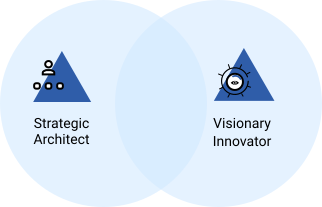
Strategic Architect + Visionary Innovator. The Visionary names an ambition the architect would have hedged, and the architect builds the staged path that makes the ambition survive a board review.
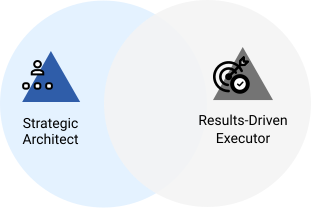
Strategic Architect + Results-Driven Executor. The architect's milestone calendar can become the executor's quarter-by-quarter delivery plan, and the executor's pace data feeds back into which milestones are real and which are aspirational.
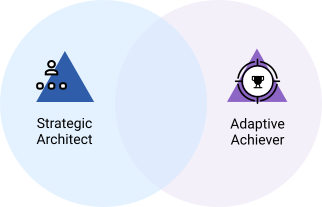
Strategic Architect + Adaptive Achiever. The Adaptive Achiever flags when conditions have moved past the scenario set, and the architect re-cuts the roadmap rather than defending an obsolete plan.
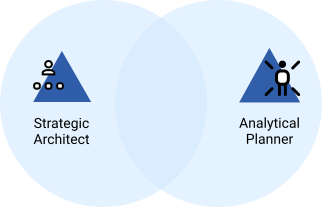
Strategic Architect + Analytical Planner. The Analytical Planner stress-tests the assumptions inside the roadmap, surfacing the few that, if wrong, break the whole plan.
When execution partners are present, the strategic architecture becomes the roadmap others execute, adapt, and enhance[5][6]. Without them, it stays a document.
In closing
The Strategic Architect isn't a leadership style to celebrate or correct. It's one of 20 patterns SynapseScope models. The fit between the pattern and the role — and the operators around the leader — determines whether the value compounds or the team burns out. Read about all 20 personas →
References & Sources
Research Foundations
- Keating, G. (2012). Netflixed: The Epic Battle for America's Eyeballs. New York: Portfolio/Penguin. Also documented in Gomes, L. (2013). "How Netflix Reversed Sagging Fortunes." MIT Technology Review, June 25, 2013. Cited for: Netflix's strategic architecture transitioning from DVD business (100% revenue in 2007) to streaming dominance by 2013, including decade-long roadmap that balanced streaming launch while DVDs funded infrastructure, content library building while predicting licensing cost explosions, and original content launch before licenses expired. Netflix grew from $1.2B to $300B+ market cap while Blockbuster filed bankruptcy (2010).
- Based on SynapseScope's leadership database (December 2025), Strategic Architects represent approximately 5-7% of assessed leaders across multiple industries and organizational levels. Cited for: Prevalence estimate for leaders combining high Visionary Orientation (strategic imagination, long-term thinking), high Foresight Capability (anticipatory planning, trend detection), and Cautious Risk Management (careful assessment, thorough evaluation).
- Mumford, M. D., Friedrich, T. L., Caughron, J. J., & Byrne, C. L. (2007). Leader cognition in real-world settings: How do leaders think about crises? The Leadership Quarterly, 18(6), 515-543. Also Zaccaro, S. J. (2001). The Nature of Executive Leadership: A Conceptual and Empirical Analysis of Success. Washington, DC: American Psychological Association. Cited for: Research in leadership and organizational psychology characterizing strategic decision-making as drawing on multiple cognitive processes together — creative ideation to generate novel possibilities, analytical pattern-detection and forecasting, and executive-function processes that organize information into coherent strategic frameworks.
- Nadella, S., Shaw, G., & Nichols, J. T. (2017). Hit Refresh: The Quest to Rediscover Microsoft's Soul and Imagine a Better Future for Everyone. New York: HarperBusiness. Cited for: Satya Nadella's multi-year strategic roadmap transforming Microsoft from desktop software to cloud-first, including cultural transformation, competitive positioning, market shift anticipation, and technology trend navigation.
- Shantanu Narayen interview documented in Krazit, T. (2013). "Adobe's Subscription Model Transition: A Multi-Year Journey." Gigaom, October 2013. Also Adobe Inc. annual reports 2012-2015 documenting Creative Cloud transition. Cited for: Adobe's strategic architecture transitioning from boxed software to cloud subscription (Creative Cloud), balancing visionary SaaS leadership goals with anticipated customer resistance, revenue model transitions, and competitive responses through multi-year roadmap.
- Catmull, E., & Wallace, A. (2014). Creativity, Inc.: Overcoming the Unseen Forces That Stand in the Way of True Inspiration. New York: Random House. Also Iger, R. (2019). The Ride of a Lifetime: Lessons Learned from 15 Years as CEO of the Walt Disney Company. New York: Random House. Cited for: Disney's $7.4 billion acquisition of Pixar (2006) success through strategic architecture that imagined creative synergies while anticipating cultural integration challenges, preserving Pixar's innovation culture while leveraging Disney's distribution power.
- Gallagher, L. (2017). The Airbnb Story: How Three Ordinary Guys Disrupted an Industry, Made Billions… and Created Plenty of Controversy. Boston: Houghton Mifflin Harcourt. Also news coverage of Airbnb's May 2022 China market exit and the divergent European city-level regulatory frameworks (Berlin, Paris, and Amsterdam licensing/occupancy rules vs. Barcelona, Palma de Mallorca, and Vienna restrictions). Cited for: Airbnb's market-by-market global expansion, including the China entry and 2022 exit and the contrast between European cities that negotiated regulatory frameworks and those that imposed bans on short-term rentals.
- Volkswagen AG press materials and product information for the ID. program (announced at the Frankfurt Motor Show, September 2019, with the ID.3 as the first MEB-platform production model). Also General Motors press materials from the March 2020 Ultium platform reveal at the GM Technical Center in Warren, Michigan, describing a multi-brand, multi-segment EV strategy spanning Chevrolet, Cadillac, GMC, and Buick. Cited for: The existence and architecture-style framing of the VW ID. and GM Ultium programs as multi-year EV transition roadmaps that map battery technology, manufacturing scale, and platform planning across brands and vehicle segments.
Assessment Methodology
SynapseScope's Leadership Assessment identifies Strategic Architects through behavioral patterns across eight dimensions. This persona combines high Visionary Orientation (strategic imagination, long-term thinking, transformational vision), high Foresight Capability (anticipatory planning, trend detection, predictive analysis), and Cautious Risk Management (careful assessment, thorough evaluation, stability preference). Prevalence statistics derived from SynapseScope's leadership database (December 2025). For technical documentation on assessment methodology and validation, see Spectrum Foundation Research.
Discover Your Leadership Persona
Every organization needs all 20 leadership personas to thrive. Strategic Architects are just one piece — essential, but incomplete without the others.
Where do you fit in your organization's leadership ecosystem?