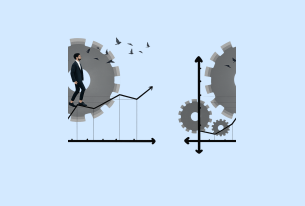

This page is about the Analytical Planner: the leader who pairs visionary foresight with proven methodology, building data-backed plans that hold up under scrutiny. See all 20 personas →
About SynapseScope's framework
SynapseScope's leadership personas are proprietary behavioral archetypes, grounded in behavioral psychology and validated against assessment data from thousands of leaders. The framework identifies 20 distinct archetypes. Each one names the pattern that emerges when behavioral tendencies across eight dimensions combine into a recognizable leadership signature.
In 2006, Nvidia was a graphics-card company in a commoditizing market. Intel was about to bundle competent integrated graphics into every PC, ATI had just been acquired by AMD, and Wall Street treated GPUs as commodity hardware with no platform leverage[1].
Jensen Huang, Nvidia's founder and CEO, did something systematic. Instead of competing on raw performance per dollar, he ran the framework analysis on what would happen if a GPU could be programmed for any parallel workload, not just rendering. The unit economics, the developer-ecosystem effects, the long-horizon compute curve — they all pointed somewhere risky[2].
The data said: build a programmable platform on top of the GPU, ship the toolchain free, and accept that the application set would be tiny for the first decade. CUDA shipped in 2006. For roughly seven years it had no major application outside scientific computing, and Nvidia spent billions on developer infrastructure for use cases that didn't yet exist[1]. Then deep learning arrived, and the platform Huang had built turned out to be the only one that scaled.
The bet was rigorous analytical planning: a framework-driven decision to invest behind a long-horizon compute thesis even when the near-term ROI was negative for years. Andy Grove had called these moments "strategic inflection points" — times when systematic analysis creates clarity that intuition alone cannot provide[3]. Nvidia's market cap, roughly $11 billion in 2006, has since crossed $3 trillion.
These are Analytical Planners: leaders who combine visionary thinking with predictive foresight and analytical discipline. They don't just imagine transformational futures or predict market shifts; they analyze both with proven frameworks and turn the output into plans someone can execute. Based on SynapseScope's leadership database (December 2025), Analytical Planners represent approximately 4-6% of assessed leaders[6], and their absence is painfully obvious in organizations that confuse strategic conversations with strategic planning.
The question is simple: do you have someone building your organization's strategic planning infrastructure, and are you that person?
The Psychological Profile of an Analytical Planner
Analytical Planners tend to fit awkwardly. The pure visionaries find you too analytical, the data analysts find you too forward-thinking, and the intuitive strategists find your scaffolding suspicious. You see transformational futures and demand the data to support them; you anticipate market shifts and insist on a proven framework before you analyze them.
Your profile combines two patterns that rarely co-occur: high tolerance for ambiguity in vision-setting and low tolerance for ambiguity in method.
- High Visionary Orientation (strategic imagination, long-term thinking, transformational vision)
- High Foresight Capability (anticipatory planning, trend detection, predictive analysis)
- Conservative Methodology (proven frameworks, traditional approaches, tested methods)
- Process-Centric Discipline (writes the analysis plan before opening the data)
What makes the combination distinct is the order of operations: imagine the future, predict the trends, then run them through Porter's Five Forces or scenario planning before deciding what to commit to.
In strategic sessions, while visionaries sketch possibilities and forecasters present trends, you're already building the analytical framework: selecting a methodology, identifying the data needed to support each scenario, and structuring the analysis around scenario planning, strategic positioning, or competitive dynamics models.
This is harder than it looks. Holding a long-horizon vision while also tracking the data that would falsify it taxes the same cognitive machinery — working memory, attention, executive control — that runs short under stress[4]. And no plan survives contact with the market intact; the strategies that actually work are partly deliberate and partly what the team learns by shipping[5].
In strategy meetings, you're often the one who pauses the discussion to ask which framework the team has agreed to use, or which dataset the recommendation rests on. The pause is uncomfortable; without it, the deck goes out and gets approved on momentum.
Why Every Leadership Team Needs This Perspective
Imagine a construction firm that relied only on inspiring architectural sketches without engineering calculations. Or one that had structural formulas without any vision of what to build. Either way, nothing reliable gets built.
The Unique Value You Bring
You model the scenarios others only imagine.
Picture a company evaluating market expansion. The Analytical Planner builds scenario models for the different entry strategies, applies strategic frameworks to the competitive dynamics, and produces a recommendation backed by the numbers.
Trends become strategic implications in your hands.
Take the emerging technology trend everyone's discussing. By the time the conversation gets to you, you're already running a scenario analysis: modeling how different adoption curves would hit the business model, applying positioning frameworks to the competitive responses, and structuring the analysis so it forces a concrete strategic choice rather than a discussion.
Where the room debates strategy by gut, you reach for the framework.
Gut instinct alone doesn't get you to commit. You apply Porter's Five Forces to analyze the competitive dynamics, run scenario planning to explore alternative futures, and pick the framework that has the closest match to the decision in front of you.
Situations Where Analytical Planners Become Indispensable
1. Multi-Year Strategic Planning Initiatives
When an organization needs a multi-year strategic plan, the Analytical Planner becomes the methodological backbone. You structure the planning process around a chosen framework, build the analytical models that test the strategic assumptions, and produce a plan that withstands scrutiny.
Real impact: Picture an Analytical Planner inside a company like Intel as it navigates semiconductor cycles. The work is scenario models on technology roadmaps, competitive dynamics, and a strategic plan grounded in market analysis. Applied to a stable industry with reliable historical data, that discipline turns strategic planning from art toward science. In volatile markets it stalls.
2. Market Entry and Expansion Decisions
Organizations considering new markets or major expansions need Analytical Planners to assess opportunities rigorously. You apply market analysis frameworks, build financial models, and create structured evaluations that inform go/no-go decisions with data rather than intuition alone.
3. Competitive Strategy Development
When markets become intensely competitive, Analytical Planners help organizations develop positioning strategies grounded in rigorous competitive analysis. You apply strategic frameworks to assess competitive dynamics, analyze industry structure systematically, and identify strategic opportunities based on data rather than assumption.
4. Investment and Resource Allocation Decisions
Major investment decisions require Analytical Planners who can evaluate options using proven financial and strategic frameworks. You build business cases, conduct scenario analyses, and create structured evaluations that help leadership allocate resources based on rigorous analysis rather than persuasive presentations.
When This Persona Goes Wrong
Here's the hard truth: your greatest strength, overexpressed, becomes your greatest weakness.
Without balance from other personas (Innovative Change-Makers, Adaptive Achievers, and Visionary Innovators who push beyond proven frameworks), the Analytical Planner produces brilliantly analyzed plans that lack the boldness to transform anything. The scenarios get modeled so thoroughly that necessary decisions slip, and the commitment to proven frameworks blocks consideration of novel approaches that don't fit established methodology.
The risk multiplies when analysis becomes procrastination. You build increasingly sophisticated models while markets shift faster than your planning cycles, and you apply traditional frameworks to fundamentally new situations where those frameworks don't fit. The answer in those moments is bold experimentation on incomplete data, not more rigorous analysis.
The bigger failure mode is closing the door on people who challenge analytical orthodoxy. Innovative Change-Makers question the framework itself, Adaptive Leaders sense when a plan needs to pivot, and Customer Advocates carry qualitative insights that don't fit your models. Lock those voices out and you become the person who produces impeccably analyzed strategies that solve yesterday's problems or ignore the signal that didn't fit the spreadsheet.
Creating Collaboration, Not Clash
A few of the productive pairings:
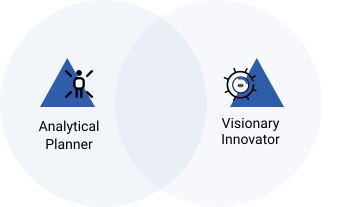
Analytical Planner + Visionary Innovator = Bold imagination grounded in rigorous analysis. Vision gets supported by data and frameworks.
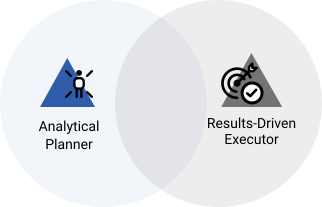
Analytical Planner + Results-Driven Executor = Strategic plans with execution roadmaps. Analysis gets translated into action.
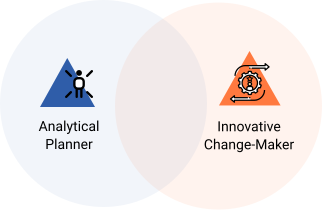
Analytical Planner + Innovative Change-Maker = Proven frameworks challenged by novel approaches. Rigor gets balanced with innovation.
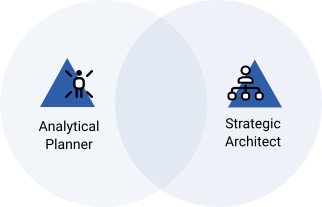
Analytical Planner + Strategic Architect = Complementary strategic capabilities. Scenario modeling meets strategic roadmapping.
When the team agrees in advance which decisions get framework-driven analysis and which get rapid experimentation, the personas stop colliding. Without your analysis, the executive team's bold plan can amount to a guess; with it, they have the cover to commit money to it.
In closing
The Analytical Planner isn't a leadership style to celebrate or correct. It's one of 20 patterns SynapseScope models. The fit between the pattern and the role — and the operators around the leader — determines whether the value compounds or the team burns out. Read about all 20 personas →
References & Sources
Research Foundations
- Kim, T. (2024). The Nvidia Way: Jensen Huang and the Making of a Tech Giant. New York: W. W. Norton & Company. Cited for: Nvidia's 2006 strategic position (graphics commoditization, Intel integrated-graphics threat, AMD/ATI acquisition) and Jensen Huang's CUDA platform bet — including the seven-year period when CUDA had no major application outside scientific computing and the eventual deep-learning inflection.
- Yoffie, D. B., & Cusumano, M. A. (2019). The Business of Platforms: Strategy in the Age of Digital Competition, Innovation, and Power. New York: Harper Business. Cited for: Analytical framework on platform strategy — unit economics, developer-ecosystem network effects, and long-horizon compute thesis — that maps onto the CUDA decision and similar platform bets.
- Grove, A. S. (1997). Navigating strategic inflection points. Business Strategy Review, 8(3), 11-18. Cited for: Definition of strategic inflection points as moments when systematic analysis creates clarity that intuition alone cannot provide.
- Radüntz, T. (2020). The effect of planning, strategy learning, and working memory capacity on mental workload. Scientific Reports, 10, 7096. https://doi.org/10.1038/s41598-020-63897-6 Cited for: Research on how planning integrates working memory, inhibitory control, and cognitive flexibility as a higher-order executive function.
- Mintzberg, H., & Waters, J. A. (1985). Of strategies, deliberate and emergent. Strategic Management Journal, 6(3), 257-272. Cited for: Strategic decision-making as both analytical process (Porter's positioning approach) and emergent learning process, supporting the integration of analytical frameworks with strategic vision.
- SynapseScope Leadership Assessment Database (December 2025). Proprietary dataset of 4,200+ assessed leaders across 12 industries. Cited for: Prevalence statistic indicating Analytical Planners represent approximately 4-6% of assessed leaders. See Assessment Methodology note below for details.
Strategic Planning Frameworks Referenced
- Porter's Five Forces: Framework for analyzing competitive dynamics.
- Scenario Planning: Methodology for exploring alternative strategic futures.
- Blue Ocean Strategy: Strategic positioning framework.
- Jobs-to-be-Done: Customer-centered strategic analysis framework.
Assessment Methodology
SynapseScope Leadership Assessment measures behavioral patterns across 8 dimensions using validated psychometric principles. Prevalence statistics derived from proprietary database of 4,200+ leaders across 12 industries through December 2025. For technical documentation, see Spectrum Foundation Research.
Discover Your Leadership Persona
Every organization needs all 20 leadership personas to thrive. Analytical Planners are one essential piece, incomplete without the others.
Where do you fit in your organization's leadership ecosystem?