
This page is about the Growth-Oriented Coach: the leader who develops people with strategic purpose, aligning individual growth with where the organization is heading. See all 20 personas →
About SynapseScope's framework
SynapseScope's leadership personas are proprietary behavioral archetypes, grounded in behavioral psychology and validated against assessment data from thousands of leaders. The framework identifies 20 distinct archetypes. Each one names the pattern that emerges when behavioral tendencies across eight dimensions combine into a recognizable leadership signature.
In 2012, Best Buy was in trouble. Amazon was eating into its share. The stock had fallen sharply from its mid-2000s peak, and many analysts were predicting the company's demise. The board brought in Hubert Joly, who did something unexpected: instead of slashing costs and closing stores first, he focused on developing people[1].
Joly called his approach "Human Magic." The core: every supervisor becomes an individual coach to every team member. Personalized coaching, not generic training, connecting each employee's growth to what the company needed to become[2].
Most turnarounds focus on strategy, cost-cutting, and restructuring. Joly built five transformation pillars, and coaching was central: connecting employees with what drives them, giving autonomy, instituting one-on-one coaching for individual training, and creating a growth mindset to continuously improve. As Joly framed it, mass training matters less than the individualized coaching that recognizes each person's distinct needs[1].
Between 2012 and 2019, Best Buy's stock rose 270% under Joly[2]. The company once dismissed as a likely casualty of e-commerce became a thriving business because someone developed people strategically, aligning individual growth with organizational transformation.
Growth-Oriented Coaches align individual development with long-term organizational vision, building capability for future needs rather than closing yesterday's gaps. Based on SynapseScope's leadership database (December 2025), this pattern shows up in roughly one in fifteen assessed leaders, and its presence is what separates random development spending from strategic capability investment.
The question is whether someone in your organization is building strategic capability deliberately, and whether that person is you.
The Psychological Profile of a Growth-Oriented Coach
Growth-Oriented Coaches sit between two camps that rarely talk to each other. Pure strategists view your people focus as soft. Pure people-developers view your strategic framing as cold. The tension you carry is wanting to invest deeply in each person's growth while ensuring that growth serves where the organization is heading.
From a behavioral and neuropsychological perspective, the pattern is a distinctive synthesis. Dweck's growth-mindset research found that people who believe ability is developable persist longer on hard tasks and outperform peers who hold fixed-mindset beliefs[3]. Coaching combined with neuroscience-informed techniques engages neuroplasticity, forming new neural connections that support lasting behavioral change[4].
You orient toward growth, focus intensely on people, adapt your approach to individual context, and think in long horizons. Coaching relationships engage neurochemistry associated with trust and motivation[5], and the brain's plasticity persists across the lifespan[6], which is why patient, individualized development pays out where standardized programs do not.
What makes the combination distinct is that you develop capability strategically rather than reactively. Coaching grounded in neuroscience-informed practice has been associated with measurable performance improvement[7]. The question you ask is not just "what does this person need to grow?" but "how does their growth align with where this organization needs to go?"
The Growth-Oriented Coach combines an emphasis on Growth-Focused development with intense People-Focused attention, calibrated Flexibility, and an underlying Visionary thread. The leader builds capability deliberately by attending to where each person can grow next, adapts the development approach to the individual rather than running everyone through the same program, and keeps a long-horizon picture of where the organization is heading so today's growth lines up with tomorrow's needs. The result is a growth-oriented culture where teams are empowered to innovate and excel while staying aligned with organizational goals. The difference between a Growth-Oriented Coach and a generic supportive manager is the visionary thread; a supportive manager develops people for who they are today, while the Growth-Oriented Coach develops them for who the organization will need them to become.
The trade-off shows up in tempo. Strategic coaching takes longer than directive instruction, and short-horizon stakeholders sometimes read it as overthinking. The work of this persona is making the case that capability built today is the substrate of execution two years out.
The Unique Value You Bring
Skills versus capability
When organizations transform strategy, the question isn't whether existing skills get refreshed but whether the capability bench can carry the new shape of the business. The Growth-Oriented Coach builds for the company the organization is becoming, not the one it has been.
Aspiration versus alignment
The high-potential employee everyone wants to develop is also a strategic question. You ask which capabilities the organization will need as it evolves, and how this person's aspirations can be developed in ways that serve both their growth and emerging priorities. Development becomes purposeful rather than only supportive, with the trade-off that some aspirations and some organizational needs will not align, and you have to be honest about that.
Reactive versus anticipatory development
Rather than waiting for performance gaps to surface, the Growth-Oriented Coach identifies capabilities the organization will need and builds toward them, growing strategic capacity before it is urgently called for. The risk is investing in capacity the organization doesn't end up needing if strategy shifts faster than the development cycle.
Situations Where Growth-Oriented Coaches Become Indispensable
1. Strategic Transformation and Capability Building
When organizations transform strategy by entering new markets, shifting business models, or adopting new technologies, Growth-Oriented Coaches build the human capability the new direction requires. The leaders developed under this approach can execute the new strategy, not just the old one.
Real impact: Netflix's shift from DVD rental to streaming to content creation illustrates the pattern[8]. Each transition demanded different leadership capabilities, and the organizations that navigated those transitions well built content expertise, creative judgment, and platform thinking ahead of when those capabilities became urgent.
2. Leadership Pipeline and Succession Development
Organizations need Growth-Oriented Coaches to build leadership pipelines aligned with future needs. The work isn't only developing today's high-potentials; it is building capabilities the organization will need in its next chapter.
Consider this: When companies face generational leadership transitions, Growth-Oriented Coaches ensure continuity by developing next-generation leaders with both the foundational capabilities and the strategic orientation needed for tomorrow's challenges.
3. Building Learning Cultures
Growth-Oriented Coaches create cultures where development is continuous, strategic, and empowering. The model is coaching that balances support with strategic purpose, producing environments where growth is both personally meaningful and organizationally valuable.
Patagonia, for example, builds a learning culture in which development serves both individual fulfillment and the company's environmental mission, so people grow in ways that align with both purpose and business[9].
4. Navigating Ambiguity and Change
When organizations face uncertainty, Growth-Oriented Coaches develop adaptive capability. The work is building judgment, strategic thinking, and resilience rather than only specific skills that may become obsolete.
Through the COVID-19 disruption, organizations whose leaders had been developed for ambiguity were often better positioned to make strategic decisions with incomplete information and lead through uncertainty in ways that did not depend on the specific shape of the crisis.
When This Persona Goes Wrong
Strategic development, taken to extremes, neglects current performance.
Without balance from other personas, particularly Results-Driven Executors, Directive Leaders, or Analytical Planners who maintain performance standards and current needs, Growth-Oriented Coaches can become so focused on future capability that current performance suffers. People get developed for where the organization is heading while urgent skill gaps go unaddressed. Strategic development that runs too long ends up neglecting today's delivery.
The risk multiplies when the orientation tips toward individual empowerment without organizational accountability. Investment goes into developing people whose aspirations don't align with organizational needs. Coaching becomes so flexible that there is no consistency or standard. Sometimes the most strategic move is clear expectations, structured programs, and accountability for current performance.
Most critically, without integration with leaders who balance development against results delivery, customer needs, and operational realities, you become the person who builds wonderful capability that doesn't translate to performance, or who develops people so strategically that they outgrow the organization before contributing value.
Creating Collaboration, Not Clash
Understanding how Growth-Oriented Coaches work with others reduces friction in cross-persona collaboration.
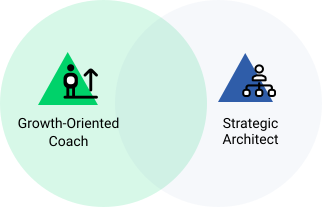
Growth-Oriented Coach + Strategic Architect = Strategic vision with the human capability to execute it; roadmaps supported by developed talent.
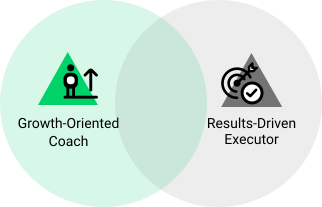
Growth-Oriented Coach + Results-Driven Executor = Strategic development balanced with performance delivery; future capability without sacrificing current results.
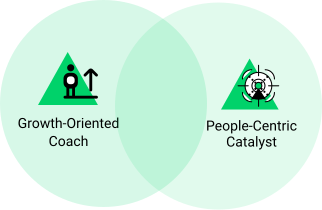
Growth-Oriented Coach + People-Centric Catalyst = Comprehensive people investment, where relationship-building meets strategic capability development.
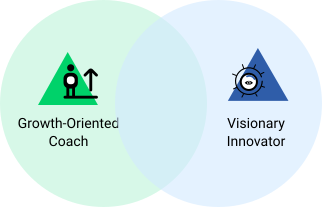
Growth-Oriented Coach + Visionary Innovator = Transformational vision matched with the capability to realize it.
In closing
The Growth-Oriented Coach isn't a leadership style to celebrate or correct. It's one of 20 patterns SynapseScope models. The fit between the pattern and the role — and the operators around the leader — determines whether the value compounds or the team burns out. Read about all 20 personas →
References & Sources
Research Foundations
- Joly, H. (2021). Former Best Buy CEO: Empowering Workers to Create 'Magic'. Harvard Business Review. Cited for: Best Buy turnaround through individual coaching and employee development.
- Harvard Business School Working Knowledge. (2023). Best Buy: How Human Connection Saved a Failing Retailer. Cited for: Joly's "Human Magic" approach, coaching transformation pillars, and 270% stock price increase.
- Dweck, C. S. (2006). Mindset: The New Psychology of Success. Random House. Cited for: Growth mindset research showing beliefs about ability development shape learning outcomes.
- Co-Active Training Institute. (2024). The Neuroscience of Change: How Coaching Rewires the Brain. Cited for: Neuroplasticity research showing coaching forms new neural connections enabling behavioral change.
- Jack, A. I., Boyatzis, R. E., Khawaja, M. S., Passarelli, A. M., & Leckie, R. L. (2013). Visioning in the brain: an fMRI study of inspirational coaching and mentoring. Social Neuroscience, 8(4), 369-384. Cited for: fMRI evidence that compassion-based coaching engages parasympathetic activity and reward-related brain regions (including the nucleus accumbens) associated with positive affect and motivation.
- Goldberg, H. (2022). Growing Brains, Nurturing Minds—Neuroscience as an Educational Tool to Support Students' Development as Life-Long Learners. Brain Sciences, 12(12), 1622. Cited for: Research on lifelong brain plasticity and learning capacity.
- Global Wellness Institute. (2024). The Neuroscience of Coaching. Cited for: How neuroscience-informed coaching engages neuroplasticity and attention to support measurable behavioral change.
- Wikipedia contributors. (2026). Netflix. Wikipedia. Cited for: Netflix's progression through DVD rental (founded 1997), streaming launch (2007), and original content production (House of Cards, 2013).
- CultureMonkey. (2024). Patagonia company culture in action: How HR can apply these values anywhere. Cited for: Patagonia's purpose-integrated development approach where employee growth is aligned with the company's environmental mission through workshops, training, and mission-aligned work.
Assessment Methodology
SynapseScope Leadership Assessment measures behavioral patterns across 8 dimensions using validated psychometric principles. Prevalence statistics derived from proprietary leadership database (December 2025). For technical documentation on the Spectrum Foundation framework, see Spectrum Foundation Research.
Discover Your Leadership Persona
Every organization needs all 20 leadership personas to thrive. Growth-Oriented Coaches are just one piece, essential but incomplete without the others.
Where do you fit in your organization's leadership ecosystem?