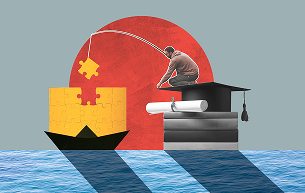

This page is about the Prudent Planner: the leader who combines transformational vision with careful risk assessment, pursuing bold futures through disciplined planning. See all 20 personas →
About SynapseScope's framework
SynapseScope's leadership personas are proprietary behavioral archetypes, grounded in behavioral psychology and validated against assessment data from thousands of leaders. The framework identifies 20 distinct archetypes. Each one names the pattern that emerges when behavioral tendencies across eight dimensions combine into a recognizable leadership signature.
Elizabeth Holmes envisioned revolutionizing blood testing. Elon Musk envisioned revolutionizing space travel. Both visions were transformationally ambitious.
Holmes pursued her vision by ignoring risk signals. Engineers raised concerns about test accuracy. Scientists questioned whether the technology was viable. Holmes pushed past those warnings, and by 2018, Theranos had collapsed[1].
Musk pursued his vision by obsessing over risk management. SpaceX's early rockets failed repeatedly. Each failure was anticipated, analyzed, and learned from[2]. Musk imagined transformational futures while building exhaustive failure-mode analyses, contingency plans, and careful stage-gating. He dreamed of Mars while testing parachutes.
Prudent Planners combine transformational vision with disciplined risk assessment. They imagine bold futures and ask what could go wrong before committing resources.
Your organization has bold visionaries who inspire transformation. You have risk managers who identify potential failures. But without someone who can hold both, dreaming boldly while planning cautiously, you have either reckless vision or timid incrementalism.
You need someone who imagines transformational futures and designs careful pathways to reach them.
The question is: Do you have someone who combines visionary thinking with prudent planning, and are you that person?
The Psychological Profile of a Prudent Planner
Prudent Planners often feel caught between worlds. If you're one, you've probably experienced the tension of having ambitious visions while feeling compelled to plan meticulously. Pure risk managers find you too visionary. Bold innovators find you too cautious. You dream big, and you also need a carefully constructed safety net.
From a behavioral psychology perspective, you represent a distinctive and often misunderstood profile, marked by high risk aversion (cautious decision-making that prioritizes security and stability), high visionary orientation (strategic, forward-focused, long-term thinking), conservative methodology (a preference for practical, tested approaches), and strong foresight (anticipatory planning balanced with adaptive flexibility).
Here's what makes this combination psychologically distinct. You don't just want to pursue bold visions. You need to plan them so risk doesn't kill them, and you need contingencies for the methods that fail. This is ambitious imagination combined with prudent execution.
Your mind works differently in strategic discussions. Pure visionaries imagine transformational futures. Pure risk managers anticipate problems. You're doing both at once, planning every contingency and identifying proven approaches that could work.
The difference between a Prudent Planner and a Stability Guardian is the visionary thread; a guardian protects what works without imagining what's next, while the Prudent Planner imagines transformational futures and slows the path to reach them.
In our work with SynapseScope assessment data, organizations that pair visionary leaders with risk-aware planners tend to report fewer transformation reversals than those weighted toward either extreme. The lived experience is harder: holding both views at once means being dismissed by visionaries as 'not bold enough' and by risk managers as 'too ambitious,' with thorough risk assessment relabeled as 'analysis paralysis.'
The Unique Value You Bring
When others choose between bold vision and careful planning, you do both.
When Warren Buffett invests, he holds a deeply visionary read on where industries are heading while approaching each investment with extreme caution, proven valuation methods, and meticulous risk assessment[3]. Buffett's pairing of visionary industry conviction with strict valuation discipline has produced roughly 20% compounded annual returns at Berkshire Hathaway across the six decades since 1965, in conditions of stable U.S. capital markets[7].
When others pursue transformation recklessly, you build careful roadmaps.
IBM's services-led pivot in the 2000s, documented by Harreld, O'Reilly, and Tushman, used staged change management with risk mitigation at each phase[4]. Prudent Planners did not just envision the future; they sequenced the transition through proven methodologies and kept risk controls live at every stage.
When others see vision and caution as opposites, you prove they're complements.
You understand what sustainable transformation requires: ambitious goals pursued through disciplined planning that anticipates risks, validates approaches, and builds safety nets. Careful planning tends to enable bolder visions than reckless execution can sustain in domains where failure is irreversible (regulated industries, infrastructure, life-critical systems).
Situations Where Prudent Planners Become Indispensable
1. High-Stakes Strategic Transformation
When organizations need fundamental transformation in high-stakes contexts (healthcare, finance, infrastructure), where failure has severe consequences, Prudent Planners lead. You envision transformational futures while planning every risk mitigation step.
Real impact: Kaiser Permanente's HealthConnect / Epic rollout phased deployment region by region, completing across all 36 hospitals and 431 medical offices by 2010, with paper-record contingencies in place during cutovers so a single deployment failure could not compromise patient safety[8]. The transformational vision (a unified electronic medical record across an integrated delivery system) was paired with extensive testing protocols and contingencies for every failure mode.
2. Long-Term Infrastructure and Capability Building
When organizations undertake multi-year transformations that require building new capabilities, infrastructure, or systems, Prudent Planners envision the future and build toward it methodically. You don't just set 10-year goals; you create detailed roadmaps with validation milestones, using proven approaches at each stage.
Consider this: When Singapore transformed from a developing nation to a first-world economy under Lee Kuan Yew's leadership, Prudent Planners combined visionary economic planning with meticulous execution: proven education models, carefully managed urbanization, and risk-aware financial policies[5]. They achieved their transformational vision through decades of prudent planning.
3. Regulated Industry Innovation
In heavily regulated industries (pharmaceuticals, aviation, financial services), where innovation must balance visionary possibility with regulatory reality, Prudent Planners envision transformational breakthroughs while planning careful validation.
Consider this: A pharmaceutical Prudent Planner typically pairs the long-horizon vision of a revolutionary therapy with the discipline of multi-phase clinical trials, regulatory strategy, and post-market safety monitoring. The vision survives because the validation path is built around it from day one.
4. Organizational Growth with Risk Management
When organizations pursue aggressive growth (market expansion, M&A, scaling operations), Prudent Planners envision ambitious outcomes while planning risk mitigation. You pursue transformation without catastrophic failures.
When John Bogle founded Vanguard in 1975, he envisioned transforming how Americans invest, and he built the company around proven index fund methodology, careful cost management, and risk-aware strategies[6]. That combination grew into one of the world's largest asset managers over the decades that followed.
When This Persona Goes Wrong
A Prudent Planner is the wrong hire for first-mover land grabs. If your category is being defined in 18 months, hire an Innovative Change-Maker and accept the breakage; the prudent posture will cost you the window.
Without balance from other personas (particularly Innovative Change-Makers, Adaptive Achievers, or Decisive Achievers who push beyond proven methods and accept necessary uncertainty), Prudent Planners can plan transformations so carefully that they never actually transform. The vision keeps getting pushed back as risk assessment delays indefinitely. Insistence on proven methods crowds out novel approaches. Perpetual planning replaces breakthrough innovation. Sometimes the answer is not more careful planning; it is accepting uncertainty and moving forward with imperfect information.
Most critically, a Prudent Planner who can't integrate perspectives from leaders comfortable with rapid experimentation, creative innovation, and bold action becomes the person who creates transformation plans that are never implemented, or who pursues visions that are outdated by the time they have been validated thoroughly enough.
If you're reading this and thinking "but these visions DO require careful planning," that may be exactly the warning sign. The best Prudent Planners know when thorough planning enables transformation and when it tips into paralysis.
Creating Collaboration, Not Clash
Understanding how Prudent Planners work with others transforms friction into breakthrough:
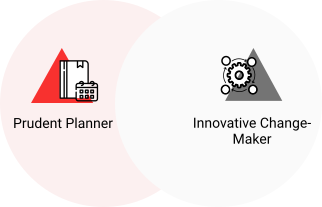
Prudent Planner + Innovative Change-Maker = Bold innovation with risk mitigation; creative experimentation protected by careful validation.
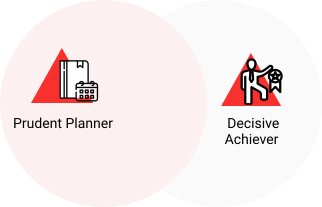
Prudent Planner + Decisive Achiever = Strategic vision with execution speed; ambitious goals balanced between planning and action.
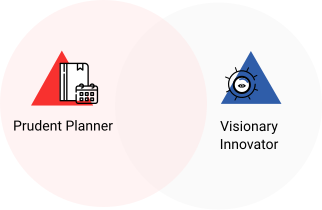
Prudent Planner + Visionary Innovator = Transformational imagination with implementation roadmaps; pure vision grounded in achievable plans.
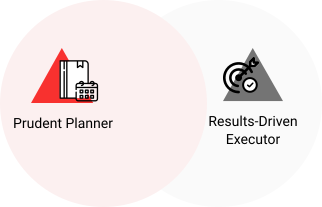
Prudent Planner + Results-Driven Executor = Long-term transformation delivered reliably; strategic planning meets execution discipline.
When teams understand each persona's value, differences become complementary. The combination of vision and caution lets organizations pursue transformations that pure visionaries cannot plan and pure risk managers will not attempt.
In closing
The Prudent Planner isn't a leadership style to celebrate or correct. It's one of 20 patterns SynapseScope models. The fit between the pattern and the role — and the operators around the leader — determines whether the value compounds or the team burns out. Read about all 20 personas →
References & Sources
Research Foundations
- Carreyrou, J. (2018). Bad Blood: Secrets and Lies in a Silicon Valley Startup. New York: Knopf. Also documented in U.S. Securities and Exchange Commission v. Elizabeth Holmes and Theranos, Inc. (2018). Cited for: Theranos collapse in 2018 after Elizabeth Holmes ignored risk signals from engineers and scientists about test accuracy and technology viability, illustrating catastrophic failure when visionary momentum overwhelms careful analysis and risk management.
- Vance, A. (2015). Elon Musk: Tesla, SpaceX, and the Quest for a Fantastic Future. New York: Ecco. Also Berger, E. (2021). Liftoff: Elon Musk and the Desperate Early Days That Launched SpaceX. New York: William Morrow. Cited for: SpaceX's approach under Elon Musk of combining visionary ambition (Mars colonization) with obsessive risk management through exhaustive failure-mode analyses, contingency planning, careful stage-gating, and learning from anticipated rocket failures, exemplifying prudent planning enabling transformational vision.
- Buffett, W. E., & Cunningham, L. A. (2013). The Essays of Warren Buffett: Lessons for Corporate America. Durham: Carolina Academic Press. Also Hagstrom, R. G. (2013). The Warren Buffett Way. Hoboken: Wiley. Cited for: Warren Buffett's investment approach combining visionary understanding of industry trends with extreme caution, proven valuation methods (value investing), and meticulous risk assessment, demonstrating how prudent planning enables ambitious vision to create legendary returns.
- Harreld, J. B., O'Reilly, C. A., & Tushman, M. L. (2007). Dynamic capabilities at IBM: Driving strategy into action. California Management Review, 49(4), 21-43. Cited for: IBM's multi-decade transformation from hardware to services to cloud/AI using carefully staged transformation plans, proven change management methodologies, and risk mitigation at every stage, illustrating bold vision executed through careful planning.
- Lee, K. Y. (2000). From Third World to First: The Singapore Story: 1965-2000. New York: HarperCollins. Also Low, L. (2001). The Singapore Developmental State in the New Economy and Polity. The Pacific Review, 14(3), 411-441. Cited for: Singapore's transformation from developing nation to first-world economy under Lee Kuan Yew's leadership through visionary economic planning combined with meticulous execution using proven education models, carefully managed urbanization, and risk-aware financial policies over decades of prudent planning.
- Bogle, J. C. (2007). The Little Book of Common Sense Investing: The Only Way to Guarantee Your Fair Share of Stock Market Returns. Hoboken: Wiley. Also Bogle, J. C. (2001). John Bogle on Investing: The First 50 Years. New York: McGraw-Hill. Cited for: John Bogle founding Vanguard in 1975 with vision to transform American investing through proven index fund methodology, careful cost management, and risk-aware strategies, creating the world's largest mutual fund company through bold vision executed with prudent planning.
- Berkshire Hathaway Inc. (2025). 2024 Annual Report. Berkshire's Performance vs. the S&P 500 (front-page table). Omaha: Berkshire Hathaway Inc. Retrieved from https://www.berkshirehathaway.com/. Cited for: Berkshire Hathaway's reported compounded annual gain of approximately 19.9% from 1965 through 2024, supporting the "roughly 20% compounded annual returns over six decades" formulation in the article. The first-page Berkshire-vs-S&P 500 performance table is published in every Berkshire annual report.
- Chen, C., Garrido, T., Chock, D., Okawa, G., & Liang, L. (2009). The Kaiser Permanente Electronic Health Record: Transforming and Streamlining Modalities of Care. Health Affairs, 28(2), 323-333. Also Liang, L. L. (Ed.). (2010). Connected for Health: Using Electronic Health Records to Transform Care Delivery. San Francisco: Jossey-Bass. Cited for: Kaiser Permanente's HealthConnect / Epic phased regional rollout, completing across 36 hospitals and 431 medical offices by 2010, with paper-record contingencies during cutovers as part of patient-safety risk mitigation. Documents the staged deployment approach and clinical safety contingencies.
Case Examples Referenced
- Theranos/Elizabeth Holmes - Used to illustrate catastrophic failure when visionary ambition lacks prudent planning and risk management, where ignoring engineer and scientist concerns led to company collapse, demonstrating necessity of careful analysis alongside bold vision.
- SpaceX/Elon Musk - Exemplifies Prudent Planner approach combining transformational vision (Mars colonization) with obsessive risk management, failure-mode analysis, and learning from anticipated failures, showing how prudent planning enables rather than constrains bold vision.
- Warren Buffett - Demonstrates investment approach balancing visionary industry understanding with extreme caution and proven valuation methods, creating legendary returns through combining ambition with disciplined risk assessment.
- IBM Transformation - Illustrates multi-decade strategic transformation using carefully staged plans and proven methodologies with risk mitigation, showing how Prudent Planners enable sustained organizational reinvention.
- Singapore Development - Demonstrates nation-building through visionary economic planning executed with meticulous care using proven models and risk-aware policies over decades.
- Vanguard/John Bogle - Exemplifies transforming an industry (American investing) through bold vision executed with proven methodology and careful risk management, creating largest mutual fund company through prudent planning.
Assessment Methodology
SynapseScope Leadership Assessment identifies Prudent Planners through behavioral patterns including high risk aversion (cautious decision-making, security prioritization), high visionary orientation (strategic, forward-focused thinking), conservative methodology (valuing proven approaches), and strong foresight (anticipatory planning with adaptive flexibility). For technical documentation, see Spectrum Foundation Research.
Discover Your Leadership Persona
Every organization draws on all 20 leadership personas to thrive. Prudent Planners are just one piece, essential but incomplete without the others.
Where do you fit in your organization's leadership ecosystem?