

This page is about the Agile Strategist: the leader who pivots decisively in volatile markets while holding directional clarity through the change. See all 20 personas →
About SynapseScope's framework
SynapseScope's leadership personas are proprietary behavioral archetypes, grounded in behavioral psychology and validated against assessment data from thousands of leaders. The framework identifies 20 distinct archetypes. Each one names the pattern that emerges when behavioral tendencies across eight dimensions combine into a recognizable leadership signature.
In 2007, Netflix made a bet that terrified Wall Street. They were the dominant DVD rental company with a proven business model. Then they launched streaming, cannibalizing their core business before anyone forced them to[1].
Traditional competitors like Blockbuster analyzed the streaming market carefully. They formed committees, commissioned studies, debated cannibalization risks. By the time they decided to act, Netflix owned the category[7].
But Netflix didn't stop there. In 2013, they pivoted again, from content distributor to content producer, launching *House of Cards* and transforming into a studio[2]. By 2020, they were releasing over 1,500 hours of original content annually. Reed Hastings promoted Ted Sarandos to co-CEO specifically because of his ability to make rapid content decisions[2].
Two pivots in six years, both executed before the market demanded them: DVD to streaming in 2007[1], streaming to studio in 2013[2].
Today: 302 million paid subscribers, $43.5-44.5 billion projected 2025 revenue[3]. Competitors who moved cautiously? Blockbuster filed for Chapter 11 in September 2010[7]. Cable companies lost millions of subscribers as cord-cutting accelerated.
This wasn't luck. It was agile strategy: the ability to pivot decisively while maintaining direction. Netflix's culture of "decentralized decision-making" and "flat hierarchy" enabled rapid pivots that rigid competitors couldn't match[4].
These are Agile Strategists: leaders who combine extreme flexibility with visionary pragmatism and calculated risk-taking. Agile Strategists leverage uncertainty rather than absorb it.
The question isn't whether speed matters in your industry. It's whether you have leaders who can move at the right velocity, and whether you're one of them.
The Psychological Profile of an Agile Strategist
Agile Strategists often feel constrained in slow-moving environments. If you're one, you've watched a market window close while a committee was still building its decision tree. Methodical planners think you're rushing. Chaos-embracing reactors think you're rigid. You see possibilities in disruption that others miss; you also miss risks that more deliberate leaders would catch.
From a behavioral psychology perspective, your profile is rare and easy to mislabel:
- Extreme Adaptability (highly flexible, open-minded, thrives on rapid change)
- Visionary Pragmatism: long-horizon bets that survive contact with operations
- Calculated Bold Moves (primarily risk-taking with measured caution)
You think and act in the same motion. You maintain directional clarity while moving faster than your peers can process. You stay flexible, hold a long-range view, and take measured risks. When conditions shift, you change course fast, keep the long-horizon goal intact, and commit before the picture is fully drawn. Your team gets to decide and move while competitors are still gathering inputs. The difference between an Agile Strategist and a chaos-embracing reactor is the visionary thread; a reactor pivots without holding it.
Your mind works differently when conditions shift. While methodical leaders want more data and reactive leaders move without direction, you're doing both: rapidly assessing the landscape while making bold calls. You understand that in dynamic environments, speed often matters more than perfection.
Research on competitive advantage shows that organizations responding quickly to market shifts while maintaining coherence outperform both slow-deliberate planners and fast-directionless reactors[5].
You've probably felt dismissed as "not thoughtful enough" by planners and "too structured" by pure improvisers. You've had your rapid pivots called "impulsive," as if decisiveness weren't what dynamic markets reward. You see opportunities in change faster than others process that change is happening.
The Agile Strategist profile is one of 20 personas SynapseScope models. It names a recurring behavioral pattern, not a hard taxonomy: leadership is hybrid more often than not, and the boundary between adjacent personas is real rather than absolute.
The Unique Value You Bring
Speed in deciding
When Amazon entered new markets, AWS launched in 2006 against zero internal demand for the product (Andy Jassy ran the team)[8], and Whole Foods was acquired in 2017 for $13.7B with the deal closing in under three months from announcement[9]. Speed and direction were necessary for Amazon's position. They weren't enough on their own. Amazon had also burned roughly $3B in operating losses through the early-2000s dot-com era[8], the kind of deficit most boards would have rejected.
Pattern recognition under noise
In Q2 2020, Chipotle accelerated its Chipotlane digital-pickup rollout from a multi-year roadmap to under twelve months; digital sales reached roughly half of revenue by Q4[10]. The persona's edge is reading a real shift early, not running a faster version of the standard plan.
Calibrated risk
Being first only wins when customers get locked in or when everyone gathers on the same platform[6]. Where they can switch easily, the better product wins regardless of who shipped first[6]. For Agile Strategists, the bias toward bold action pays off against slow incumbents in markets with low switching costs. It backfires when the move can't easily be undone.
Situations Where Agile Strategists Become Indispensable
1. Rapidly Evolving Markets and Disruption
When industries face constant technological shifts, evolving preferences, or competitive threats, Agile Strategists thrive. You don't merely respond to disruption; you use it to create advantage through rapid pivots.
Real impact: Spotify launched as a streaming service in 2008, acquired Gimlet and Anchor in February 2019 to enter podcasts, and added audiobooks via the Findaway acquisition that closed in 2022: three pivots inside one big bet on audio[11], each executed before competitors finished sizing the opportunity.
2. Startup Growth and Market Entry
Organizations entering new markets or scaling startups need Agile Strategists who move quickly with calculated risk-taking. You don't over-plan entries; you launch rapidly, learn fast, pivot based on feedback, and capture opportunities competitors are still analyzing.
Consider this: Stripe shipped its first API to a small beta cohort of Y Combinator companies in 2010; the public launch in September 2011 took payments live in under a year[12], while incumbents like Authorize.Net typically required several weeks of API integration and merchant onboarding for comparable deployments.
3. Turnaround and Crisis Response
Organizations facing existential threats need Agile Strategists who make bold calls without perfect information. You assess rapidly, decide confidently, redirect resources decisively, and move faster than the crisis evolves.
Real impact: When Domino's faced its 2009 brand crisis, CEO Patrick Doyle ran the "Pizza Turnaround" campaign in 2009–2010, publicly acknowledging quality problems, completely redesigning the recipe, and rebuilding digital ordering on a single coordinated timeline[13].
4. Innovation-Driven Competitive Positioning
When competitive advantage requires constant innovation, Agile Strategists experiment rapidly while maintaining coherence. You don't let perfect be the enemy of good; you launch quickly, learn fast, scale what works, kill what doesn't before competitors finish planning.
Tesla's 2018 "production hell" — Musk sleeping on the Fremont factory floor while pulling Model 3 line redesigns mid-ramp — is the textbook case: a pivot inside a pivot inside a fixed long-horizon goal[14]. Tesla's 2018 cash crunch reportedly came within single-digit weeks of insolvency, by Musk's own account[15]; the same iteration cadence that won the EV race nearly killed the company.
When This Persona Goes Wrong
Here's the hard truth: your greatest strength, overexpressed, becomes your greatest weakness.
Without balance from other personas (Analytical Planners, Stability Guardians, Structured Strategists), Agile Strategists pivot so rapidly that teams lose coherence. You make bold moves without sufficient risk assessment. Your speed prevents the deep thinking needed for transformational breakthroughs. You thrive on change so much that you create unnecessary turbulence.
The risk multiplies when speed becomes impulsiveness. You pivot so frequently that nothing gets fully implemented. You're so comfortable with uncertainty that you miss risks others would catch. You move so fast that people can't keep up. Sometimes the answer isn't faster pivoting; it's committing deeply to one direction and executing thoroughly.
Most critically: if you can't integrate perspectives that pair speed with diligence (analysts who run risk assessments, operators who hold stability while you move), you become the leader who moves impressively fast toward mediocre outcomes, or who burns out teams through constant pivots.
If you're reading this and thinking "but markets DO require speed," that might be the warning sign. The best Agile Strategists distinguish a calculated risk from recklessness, and a pivot that creates advantage from one that prevents depth.
Creating Collaboration, Not Clash
Understanding how Agile Strategists work with others transforms friction into breakthrough:
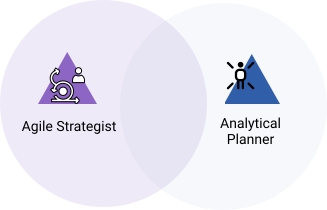
Agile Strategist + Analytical Planner = Rapid decisions informed by solid analysis: speed grounded in insight.
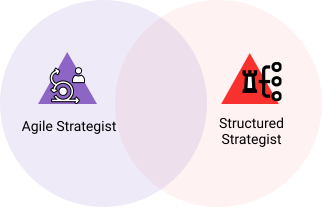
Agile Strategist + Structured Strategist = Bold pivots executed with operational discipline: nimbleness that actually gets implemented.
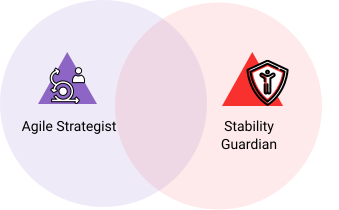
Agile Strategist + Stability Guardian = Calculated innovation with risk mitigation: bold moves protected from catastrophic failure.
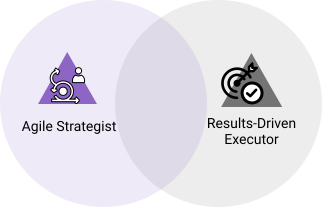
Agile Strategist + Results-Driven Executor = Quick pivots executed decisively: direction changes that drive immediate results.
Pair an Agile Strategist with an Analytical Planner and you get faster decisions with sharper risk-reads. Pair them poorly and the planner becomes a brake the strategist routes around.
In closing
The Agile Strategist isn't a leadership style to celebrate or correct. It's one of 20 patterns SynapseScope models. The fit between the pattern and the role — and the operators around the leader — determines whether the value compounds or the team burns out. Read about all 20 personas →
References & Sources
Research Foundations
- Keating, G. (2012). Netflixed: The Epic Battle for America's Eyeballs. Portfolio. Cited for: Netflix's 2007 strategic pivot from DVD rental to streaming platform, cannibalizing their core business before competitors forced them to.
- Hastings, R., & Meyer, E. (2020). No Rules Rules: Netflix and the Culture of Reinvention. Penguin Press. Cited for: Netflix's 2013 pivot into original content production with *House of Cards*, releasing 1,500+ hours annually by 2020, and Reed Hastings promoting Ted Sarandos to co-CEO for his rapid content decision-making ability.
- Netflix Q4 2024 Shareholder Letter. (2025). Netflix Investor Relations. Cited for: Netflix reaching 302 million paid memberships and projecting 2025 revenue of $43.5-44.5 billion.
- McCord, P. (2018). Powerful: Building a Culture of Freedom and Responsibility. Silicon Guild. Cited for: Netflix's decentralized decision-making culture and flat hierarchy enabling rapid strategic pivots.
- Mueller-Saegebrecht, S., & Walter, A. T. (2025). Strategic agility—An urgent capability for successful business model innovation? A conceptual process model and theoretical framework. Strategic Change, 34(3). https://doi.org/10.1002/jsc.2645 Cited for: Research showing organizations responding quickly to market shifts while maintaining coherence outperform both slow-deliberate planners and fast-directionless reactors through strategic sensitivity, leadership unity, and resource fluidity.
- Lieberman, M. B., & Montgomery, D. B. (1988). First-mover advantages. Strategic Management Journal, 9(S1), 41-58. Cited for: First-mover advantage in markets with switching costs and network effects; qualifies that first movers win when these conditions are present and lose when they aren't.
- Satell, G. (2014, September 5). A Look Back At Why Blockbuster Really Failed And Why It Didn't Have To. Forbes. Cited for: Blockbuster's slow internal deliberation around streaming and its September 23, 2010 Chapter 11 bankruptcy filing while Netflix captured the streaming category.
- Stone, B. (2013). The Everything Store: Jeff Bezos and the Age of Amazon. Little, Brown and Company. Cited for: Andy Jassy leading the AWS team through its 2006 launch with limited initial internal demand for the cloud-services product, and Amazon's accumulated dot-com-era operating deficit of roughly $3 billion through the early 2000s.
- Whole Foods Market and Amazon. (2017, June 16). Amazon to Acquire Whole Foods Market (press release); closing announced August 28, 2017. Cited for: Amazon's $13.7 billion acquisition of Whole Foods, announced June 16, 2017 and closing August 28, 2017 — under three months from announcement to close.
- Chipotle Mexican Grill. (2021, February 2). Chipotle Announces Fourth Quarter and Full Year 2020 Results. Chipotle Investor Relations. Cited for: Chipotle's accelerated Chipotlane digital-pickup rollout in 2020 and Q4 2020 digital sales reaching approximately half of total revenue (49.0%).
- Spotify. (2019, February 6 and February 14). Spotify to Acquire Gimlet Media and Spotify Acquires Anchor (press releases); Spotify. (2022, June 16). Spotify Closes Acquisition of Findaway. Spotify Newsroom. Cited for: Spotify's 2008 streaming launch, the February 2019 Gimlet and Anchor acquisitions extending into podcasts, and the 2022 Findaway acquisition extending into audiobooks.
- Collison, P., & Collison, J. (2020). Developer-first strategy and iterative scaling at Stripe. Y Combinator Case Studies; Stripe public launch announcement, September 29, 2011. Cited for: Stripe's 2010 closed beta with early Y Combinator companies and its public launch on September 29, 2011, taking payments live within a year of the first beta.
- Maze, J. (2022). How Patrick Doyle changed Domino's, and the restaurant industry. Restaurant Business. Cited for: CEO Patrick Doyle's 2009–2010 "Pizza Turnaround" campaign at Domino's, including the public acknowledgement of quality problems, the recipe redesign, and the parallel rebuild of digital ordering.
- Higgins, T. (2021). Power Play: Tesla, Elon Musk, and the Bet of the Century. Doubleday. Cited for: Tesla's 2018 Model 3 "production hell" — Musk sleeping on the Fremont factory floor while iterating production-line designs mid-ramp under a fixed long-horizon delivery goal.
- Lambert, F. (2018, November 25). Elon Musk: Tesla had "single-digit weeks" as it teetered on brink of collapse. CNBC; see also Axios coverage of the same November 2018 interview. Cited for: Musk's on-record statement that Tesla came within single-digit weeks of insolvency during the 2018 Model 3 ramp.
Assessment Methodology
SynapseScope Leadership Assessment measures behavioral patterns across 8 dimensions using validated psychometric principles. Agile Strategists represent a distinctive profile combining extreme adaptability with visionary pragmatism and calculated risk-taking. For technical documentation, see the science behind the assessment.
Discover Your Leadership Persona
Every organization needs all 20 leadership personas to thrive. Agile Strategists are one piece of the system, essential but incomplete on their own.
Where do you fit in your organization's leadership ecosystem?