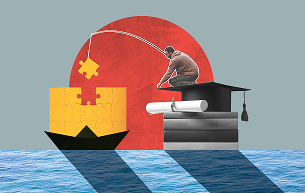

This page is about the Structured Strategist: the leader who builds operational discipline through directive oversight and rigorous process structure. See all 20 personas →
About SynapseScope's framework
SynapseScope's leadership personas are proprietary behavioral archetypes, grounded in behavioral psychology and validated against assessment data from thousands of leaders. The framework identifies 20 distinct archetypes. Each one names the pattern that emerges when behavioral tendencies across eight dimensions combine into a recognizable leadership signature.
In 2022, Southwest Airlines cancelled 16,700 flights over 10 days during the holiday season. The cause was not weather but operational chaos. Their crew scheduling system collapsed. Pilots and flight attendants couldn't reach dispatchers. Nobody knew who was supposed to work which flights. The airline that built its reputation on operational reliability failed catastrophically, stranding 2 million passengers. The pretax impact ran to $1.1 billion in refunds and compensation, and the DOT later imposed a $140 million civil penalty[1].
Southwest tried technical fixes. Better software. More staff. Improved communication tools. But the root problem wasn't technology. It was lack of operational discipline. Procedures had degraded over years. Workarounds became standard practice. No one enforced process adherence. When stress hit the system, improvisation replaced structure, and everything collapsed[1].
Recoveries from this kind of operational collapse typically require operational leaders who understand that reliable execution at scale demands structure. Standardized crew scheduling protocols. Clear escalation procedures. Rigorous process checkpoints. Directive oversight ensuring adherence. Operational reliability of that kind is rebuilt through disciplined processes and clear accountability, not through technical fixes alone.
These are Structured Strategists: leaders who create reliable execution through directive leadership and rigorous process discipline. They build operational systems that hold under pressure. They establish clear procedures and enforce standards. In SynapseScope's December 2025 assessment database, this profile appears in roughly 5–7% of assessed leaders[2]; the figure reflects who chose to be assessed and may not generalize to the leadership population at large. Their presence separates organizations that scale reliably from those that collapse under operational chaos.
The question is: Do you have someone who can build operational discipline, and are you that person?
The Psychological Profile of a Structured Strategist
By the end of this section, you'll know whether your operational discipline is the kind that scales an airline or the kind that suffocates a startup. If you're a Structured Strategist, you've watched organizations celebrate empowerment while operations deteriorate from lack of structure. You see the chaos that flexibility creates. Clear processes and directive leadership are not constraints. They enable consistent excellence.
From a behavioral psychology perspective, you represent a critical but often misunderstood profile:
- High Directive Orientation (highly structured, prescriptive, ensures clear expectations)
- High Process-Centric Focus (rigidly committed to processes, maintains standards and consistency)
- Strong Reliability (predominantly dependable, upholds high standards, minimal flexibility)
- Execution Excellence (primarily task-oriented, organizes efficiently)
Here's what's different about this combination. You engineer operations through clear structure and process discipline; consistency is enforced rather than hoped for, through defined procedures and directive oversight. Call it micromanagement if you want; the planes still land on time.
The difference between a Structured Strategist and a Stability Guardian is the directive thread; a Stability Guardian conserves what works, while a Structured Strategist actively builds and enforces the structure that makes the work hold.
Research on high-reliability organizations shows that operations requiring consistent quality (manufacturing, healthcare, aviation) achieve excellence through structured processes and directive leadership, not through flexibility and empowerment[3].
Why Every Leadership Team Needs This Perspective
WeWork in 2018 empowered everyone, valued flexibility over consistency, and treated process discipline as bureaucracy. The result was the September 2019 IPO collapse and a valuation reset from roughly $47 billion to about $10 billion within months[8]. Creative, adaptable, and incapable of delivering reliable quality.
The Unique Value You Bring
When others empower without structure, you provide the discipline that enables excellence.
When The Ritz-Carlton maintains legendary service quality across hundreds of properties globally, it's because Structured Strategists built rigorous service standards, defined clear procedures, and established directive quality oversight[4]. Structure creates that consistency; empowerment alone does not.
When others see processes as bureaucracy, you see them as excellence enablers.
Six Sigma transformed manufacturing quality at Motorola and GE. Structured Strategists built the frameworks that made it work: DMAIC stages, defined quality gates, and enforced disciplined execution[5]. That process-centric approach produced measurable excellence.
When others celebrate flexibility, you create the reliability that customers actually value.
Customers don't ask for creativity when they're being intubated, or when their plane is on final approach. They ask for the procedure to go the way it's gone ten thousand times before. That comes from clear processes and directive oversight, not from empowered flexibility.
Situations Where Structured Strategists Become Indispensable
1. High-Volume Operations Requiring Consistency
When operations must deliver consistent quality at scale, Structured Strategists build excellence through process discipline. While others debate empowerment approaches, you're establishing clear procedures, quality gates, and directive oversight that ensure reliability.
Real impact: UPS's ORION routing system, deployed across U.S. drivers by 2016, illustrates the structured approach: defined procedures, measured outputs, directive management[6]. That structured approach turns logistics complexity into reliable execution.
2. Quality-Critical Operations and Compliance
Organizations operating in heavily regulated environments (pharmaceutical electronic records, commercial aviation, healthcare data privacy, and similar regimes) need Structured Strategists to ensure quality through process discipline. You don't just meet standards; you build the structural systems that make compliance consistent across audits, shifts, and personnel changes.
Consider this: regulated environments fail not when standards are unknown but when adherence drifts. Structured Strategists are the leaders who hold the line: who own the procedure document, sign off on the deviation, and trace the breach back to the missing checkpoint.
3. Operational Turnaround and Performance Recovery
When operations are failing from lack of discipline, Structured Strategists restore performance through structure. The work is to build the processes and oversight that make better performance reproducible, provided front-line managers enforce them.
Real impact: When automakers and suppliers have rebuilt quality after high-profile safety failures, the work has typically run on process discipline of the kind operational recoveries demand: tightened statistical controls, written procedures, and named-owner quality gates, not motivational rhetoric.
4. Scaling Operations While Maintaining Quality
When organizations scale rapidly, quality often deteriorates without structure. Structured Strategists maintain excellence during growth by building scalable processes, clear procedures, and directive oversight systems that work at any volume.
Chipotle's initial success came from Structured Strategists who built clear food prep procedures, quality standards, and operational discipline that ensured consistency across locations. When that structure loosened, the 2015 E. coli outbreaks — 60 confirmed cases across 14 states[7] — followed a documented breakdown of food-prep protocols.
When This Persona Goes Wrong
Here's the hard truth: your greatest strength, overexpressed, becomes your greatest weakness.
Without balance from other personas (particularly Innovative Change-Makers, People-Centric Catalysts, or Adaptive Achievers who bring creative innovation, people development, and adaptive flexibility), Structured Strategists can build such rigid systems that organizations can't adapt when contexts change. You enforce processes so strictly that you miss opportunities requiring flexibility. Your directive leadership prevents people development through empowerment. You optimize current operations brilliantly while missing strategic shifts that make those operations obsolete.
The risk multiplies when structure becomes the goal rather than the means. You build such complex process frameworks that work slows rather than improves. You're so directive that people stop thinking for themselves. You maintain processes so rigidly that you can't respond to changing customer needs or market conditions. Sometimes the answer isn't more process discipline; it's adaptive flexibility or creative innovation.
If you're reading this and thinking "but operations DO require discipline and structure," that may be the warning sign. The best Structured Strategists know which side of that line they're on at any given moment.
Creating Collaboration, Not Clash
Understanding how Structured Strategists work with others transforms friction into breakthrough:
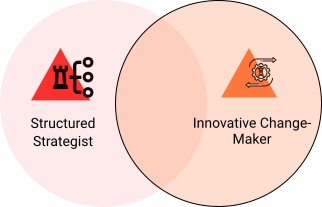
With an Innovative Change-Maker, you implement bold ideas through disciplined execution; their creativity finds a stable runway in your operational structure.
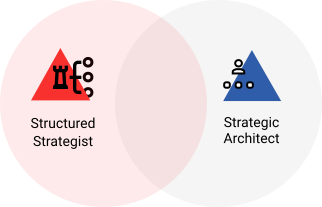
With a Strategic Architect, long-term vision becomes operational procedure; their roadmaps land as something the organization can actually run.
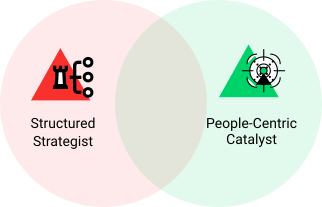
A People-Centric Catalyst softens your structure with human sustainability, balancing the rigor with development that keeps the team intact.
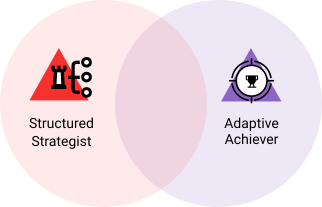
An Adaptive Achiever adds the contextual flexibility your reliability sometimes lacks, tuning the process when conditions shift faster than the document can.
When teams understand each persona's value, differences become complementary. When paired with leaders who own innovation and adaptation, your structural discipline gives them a stable base to push from. Without that pairing, the same discipline becomes a ceiling.
In closing
The Structured Strategist isn't a leadership style to celebrate or correct. It's one of 20 patterns SynapseScope models. The fit between the pattern and the role — and the operators around the leader — determines whether the value compounds or the team burns out. Read about all 20 personas →
References & Sources
Research Foundations
- Koenig, D. (2022). "Southwest Airlines cancels more than 2,800 flights as storm disruptions continue." Associated Press, December 27, 2022. Also U.S. Department of Transportation (2023). "Consent Order: Southwest Airlines Co." Docket DOT-OST-2023-0065 detailing $140M penalty for December 2022 operational failures. Cited for: Southwest Airlines December 2022 operational collapse: 16,700 flights cancelled over 10 days, 2 million passengers stranded, $1.1 billion in refunds and compensation. Root cause: degraded operational discipline, procedures abandoned in favor of workarounds, lack of process adherence causing crew scheduling system failure when stress hit the system.
- Based on SynapseScope's leadership database (December 2025), Structured Strategists represent approximately 5-7% of assessed leaders across multiple industries and organizational levels. Cited for: Prevalence estimate for leaders combining high Directive Orientation (highly structured, prescriptive), high Process-Centric Focus (rigidly committed to processes, maintains consistency), strong Reliability (predominantly dependable, high standards), and Execution Excellence (primarily task-oriented, efficient organization).
- Weick, K. E., & Sutcliffe, K. M. (2007). Managing the Unexpected: Resilient Performance in an Age of Uncertainty. San Francisco: Jossey-Bass. Also Roberts, K. H. (1990). Managing high reliability organizations. California Management Review, 32(4), 101-113. Cited for: Research on high-reliability organizations (HROs) demonstrating that operations requiring consistent quality in manufacturing, healthcare, and aviation achieve excellence through structured processes and directive leadership rather than flexibility and empowerment.
- Michelli, J. A. (2008). The New Gold Standard: 5 Leadership Principles for Creating a Legendary Customer Experience Courtesy of the Ritz-Carlton Hotel Company. New York: McGraw-Hill. Cited for: The Ritz-Carlton's legendary service quality across hundreds of global properties maintained through rigorous service standards, defined clear procedures, and directive quality oversight systems that create consistency through structure.
- Pyzdek, T., & Keller, P. (2014). The Six Sigma Handbook (4th ed.). New York: McGraw-Hill. Also Harry, M., & Schroeder, R. (2000). Six Sigma: The Breakthrough Management Strategy Revolutionizing the World's Top Corporations. New York: Currency. Cited for: Six Sigma transformation of manufacturing quality at Motorola and GE through rigorous process frameworks (DMAIC: Define, Measure, Analyze, Improve, Control), clear quality gates, and enforced disciplined execution creating measurable excellence.
- Holland, C., Levis, J., Nuggehalli, R., Santilli, B., & Winters, J. (2017). UPS Optimizes Delivery Routes. Interfaces, 47(1), 8–23. https://doi.org/10.1287/inte.2016.0875 Cited for: UPS's ORION (On-Road Integrated Optimization and Navigation) routing system, the 2016 Franz Edelman Award–winning deployment that brought defined procedures, measured outputs, and directive management to U.S. driver routing — turning logistics complexity into reliable execution at scale.
- Centers for Disease Control and Prevention. (2016). Multistate Outbreaks of Shiga toxin-producing Escherichia coli O26 Infections Linked to Chipotle Mexican Grill Restaurants (Final Update). CDC National Center for Emerging and Zoonotic Infectious Diseases. Cited for: 2015 Chipotle E. coli outbreaks with 60 confirmed cases across 14 states, following a documented breakdown of food-prep protocols when operational discipline loosened during rapid scaling.
- Brown, E., & Farrell, M. (2021). The Cult of We: WeWork, Adam Neumann, and the Great Startup Delusion. New York: Crown. Cited for: WeWork's September 2019 IPO collapse following the S-1 prospectus withdrawal, the SoftBank rescue and Neumann's removal as CEO, and the valuation reset from approximately $47 billion in early 2019 to roughly $10 billion by late 2019.
Assessment Methodology
SynapseScope's Leadership Assessment identifies Structured Strategists through behavioral patterns across eight dimensions. This persona combines high Directive Orientation (highly structured, prescriptive, ensures clear expectations), high Process-Centric Focus (rigidly committed to processes, maintains standards and consistency), strong Reliability (predominantly dependable, upholds high standards), and Execution Excellence (primarily task-oriented, organizes efficiently). Prevalence statistics derived from SynapseScope's leadership database (December 2025). For technical documentation on assessment methodology and validation, see the science behind the assessment.
Discover Your Leadership Persona
Every organization needs all 20 leadership personas to thrive. Structured Strategists are just one piece — essential, but incomplete without the others.
Where do you fit in your organization's leadership ecosystem?