
This page is about the Visionary Innovator: the leader who imagines transformational futures through creative synthesis and calculated risk-taking. See all 20 personas →
About SynapseScope's framework
SynapseScope's leadership personas are proprietary behavioral archetypes, grounded in behavioral psychology and validated against assessment data from thousands of leaders. The framework identifies 20 distinct archetypes. Each one names the pattern that emerges when behavioral tendencies across eight dimensions combine into a recognizable leadership signature.
Nokia dominated mobile phones with 40% global market share in 2007[1]. When Apple launched the iPhone, Nokia's engineers analyzed it thoroughly. Their conclusion: interesting device, but customers want physical keyboards, removable batteries, and expandable memory. The iPhone had none of these. Nokia's leadership focused on what they did best: improving call quality, extending battery life, refining their Symbian operating system[6].
By 2013, Nokia's mobile division sold to Microsoft for $7.2 billion[2], a fraction of its former value. The problem wasn't execution; Nokia's phones were well-engineered. Arguably the problem was imagination. Nokia largely saw themselves as a phone company making better phones, while Apple imagined phones as handheld computers that would reshape how humans interact with information. Nokia kept optimizing devices.
Organizations try structural fixes when they stagnate: they commission market research, accelerate product development, expand customer feedback loops. But when the constraint is imagination, when leadership can't envision the business becoming something fundamentally different, no amount of optimization helps. The need is for someone who synthesizes disparate concepts into transformational visions rather than incremental improvements.
These are Visionary Innovators: leaders who imagine transformational futures through creative synthesis and calculated risk-taking. Transformational leadership of this kind predicts higher follower performance and satisfaction across military, industrial, and educational settings[3]. Based on SynapseScope's leadership database (December 2025), Visionary Innovators represent approximately 1.8% of assessed leaders. When paired with operators who can execute the vision, their presence separates organizations that transform industries from those that optimize themselves into irrelevance.
The question is: Do you have someone who can imagine your organization becoming something fundamentally different, and are you that person?
The Psychological Profile of a Visionary Innovator
Visionary Innovators describe the same pattern: sketching futures on whiteboards while colleagues ask for next quarter's forecast.
From a behavioural psychology perspective, this is a rare cognitive profile. SynapseScope's behavioral observation identifies four characteristics that tend to cluster, consistent with the creativity research literature[4][5]:
- High Visionary Orientation (transformational imagination, synthesis thinking)
- High Creative Drive (novelty-seeking, generative ideation, unconventional solutions)
- Calculated Risk-Taking (comfort with uncertainty, tolerance for bold moves)
- Adaptive Flexibility (contextual responsiveness, openness to emergence)
The result is the capacity to catalyze transformative initiatives that move an organization toward a future-focused, ambitious direction. The difference between a Visionary Innovator and an untethered idea-generator is the willingness to commit: a generator floats possibilities, while the Visionary Innovator picks one and stakes a horizon on it.
Why Every Leadership Team Needs This Perspective
Imagine navigating using only a map of where you've been. Every road travelled is recorded, every turn made, but the map says nothing about where to go next. Kodak, Blockbuster, and Sears are widely cited as organizations that operated this way at the moment they needed to imagine a different business[7].
Visionary Innovators provide what few others can: the capacity to imagine radically different futures and, when paired with execution partners who translate vision into roadmaps, make them feel inevitable.
The Unique Value You Bring
Movements, not markets
While competitors analyzed smartphone features, Steve Jobs imagined an entire ecosystem that would reshape how humans interact with technology, commerce, and each other[8]. The reframe attracts talent and capital. The risk: markets that don't lend themselves to that reframing get dismissed.
Constraints as creative tension
The organizational constraint everyone complains about reads, to a Visionary Innovator, as the gap that points toward a different business model. Disconnected initiatives get woven into a coherent vision of what the organization could become. The trade-off is real: not every complaint is a constraint worth reframing, and the same instinct that finds opportunity in friction can manufacture it where none existed.
Reimagining versus refining
The instinct isn't to improve a process but to question whether the process should exist. The question isn't "how do we do this better?" It's "what if we did something completely different?" That instinct is generative when applied to systems that need rebuilding, and disruptive when applied to systems that simply need to run.
Situations Where Visionary Innovators Become Indispensable
1. Industry Disruption and Reinvention
When entire industries face existential shifts, Visionary Innovators thrive. While analysts compile data and planners build scenarios, the visionary is synthesizing a transformational frame that redefines what the industry is for.
Real impact: Reed Hastings, mailing DVDs in 2007, framed Netflix's future as on-demand internet delivery rather than scheduled broadcast[9]. That frame, not a streaming forecast, guided a decade of transformation.
2. Breakthrough Product and Service Innovation
The smartphone market by the mid-2010s, with Samsung and Apple racing on features, is the kind of saturated market that needs Visionary Innovators to imagine entirely new categories. The question isn't "what features do customers want?" It's "what could we create that they don't yet know they need?"
Consider this: Elon Musk framed Tesla not as an electric-car optimizer but as transportation positioned as a software-driven ecosystem[10]. The framing attracted talent and capital that incremental improvement could not.
3. Organizational Transformation
During mergers, digital transformations, or fundamental business model changes, project plans aren't enough on their own. Organizations also need an inspiring vision of what the transformed company will become.
Real impact: When Satya Nadella took over Microsoft in 2014, he framed the move from desktop software to cloud-first as a fundamentally different company culture, business model, and market position[11]. That framing became the north star for thousands of tactical decisions.
4. Building Movements, Not Just Companies
Visionary Innovators understand that the most durable organizations operate as movements. They craft narratives about purpose and transformation that attract people to something larger than the company itself.
Patagonia, for instance, frames its purpose as using business to address the environmental crisis rather than as selling outdoor gear efficiently. That reads as a Visionary Innovator pattern: synthesizing commerce, environmentalism, and purpose into a narrative that shapes everything from product design to corporate activism.
When This Persona Goes Wrong
Here's what few people tell Visionary Innovators: your greatest strength, unchecked, becomes your greatest liability.
Without grounding from other personas, particularly Operational Executors, Strategic Architects, or Analytical Planners, Visionary Innovators can create beautiful visions that never materialize. You sketch transformational futures while the organization drowns in today's operational realities. Teams become frustrated hearing about decade-long possibilities when this quarter's targets aren't being met.
The risk multiplies when you pursue transformation in situations that genuinely need optimization. Not every problem requires reimagining the entire system. Sometimes the answer is to execute better rather than envision differently. Surrounded only by other visionaries, you can drift into abstraction that feels profound but produces nothing concrete.
The most dangerous Visionary Innovator is one who mistakes the beauty of the vision for the value of the outcome, and who dismisses the "details people" as small-minded rather than as essential partners in transformation.
If you're reading this and thinking "but my vision IS sound, everyone else just can't see it," that might be exactly the warning sign. The best Visionary Innovators surround themselves with people who challenge, ground, and execute their vision rather than people who only celebrate it.
Creating Collaboration, Not Clash
Understanding how Visionary Innovators work with others transforms friction into breakthrough:
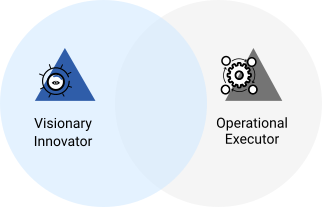
Visionary Innovator + Operational Executor = Vision meets execution: imagination grounded in delivery.
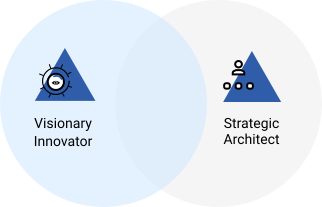
Visionary Innovator + Strategic Architect = Long-term vision combined with medium-term planning: transformation with roadmaps.
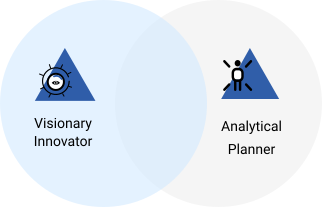
Visionary Innovator + Analytical Planner = Imaginative possibilities tested through rigorous analysis.
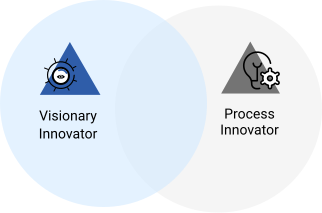
Visionary Innovator + Process Innovator = Revolutionary vision implemented through systematic innovation.
When teams understand each persona's value, differences become complementary. When the vision is communicated in language operators can act on, imaginative synthesis can become a north star others navigate toward; when it isn't, it tends to stay a sketch.
In closing
The Visionary Innovator isn't a leadership style to celebrate or correct. It's one of 20 patterns SynapseScope models. The fit between the pattern and the role — and the operators around the leader — determines whether the value compounds or the team burns out. Read about all 20 personas →
References & Sources
- TechCrunch. (2008). Over a Billion Mobile Phones Sold in 2007. Reports Nokia sold 435 million phones and gained over 40% global market share. Cited for: Nokia's 40% market dominance in 2007.
- Microsoft News Center. (2013). Microsoft to acquire Nokia's Devices & Services business. Official press release announcing $7.2 billion acquisition. Cited for: Microsoft's acquisition of Nokia's mobile division for $7.2 billion.
- Bass, B. M., & Riggio, R. E. (2006). Transformational leadership (2nd ed.). Psychology Press. Cited for: Research on how transformational leaders create organizational value through vision articulation.
- Amabile, T. M. (1996). Creativity in context. Westview Press. Cited for: Characteristics of creative leadership including novelty-seeking and transformational imagination.
- Beaty, R. E., et al. (2018). Robust prediction of individual creative ability from brain functional connectivity. Proceedings of the National Academy of Sciences, 115(5), 1087-1092. Cited for: Research on cognitive flexibility and creative cognition.
- Vuori, T. O., & Huy, Q. N. (2016). Distributed Attention and Shared Emotions in the Innovation Process: How Nokia Lost the Smartphone Battle. Administrative Science Quarterly, 61(1), 9-51. Cited for: Nokia's internal engineering response to the iPhone and continued investment in Symbian.
- Multiple sources (Wikipedia summaries cross-checked): Eastman Kodak filed for Chapter 11 in January 2012; Blockbuster LLC filed for Chapter 11 in September 2010 after declining to acquire Netflix; Sears Holdings filed for Chapter 11 in October 2018. Cited for: Kodak, Blockbuster, and Sears as widely cited examples of organizations that failed to imagine a different business at the decisive moment.
- Isaacson, W. (2011). Steve Jobs. Simon & Schuster. Cited for: Steve Jobs' framing of the iPhone as part of a broader ecosystem reshaping how people interact with technology and commerce.
- Wikipedia contributors. Reed Hastings. Documents Hastings' shift in Netflix strategy toward streaming and the 2007 launch of the streaming service. Cited for: Reed Hastings' 2007 reframing of Netflix's future toward on-demand internet delivery.
- Vance, A. (2015). Elon Musk: Tesla, SpaceX, and the Quest for a Fantastic Future. Ecco. Cited for: Musk's framing of Tesla as a software-driven ecosystem rather than an electric-car optimizer.
- Nadella, S. (2017). Hit Refresh: The Quest to Rediscover Microsoft's Soul and Imagine a Better Future for Everyone. Harper Business. Cited for: Nadella's 2014 reframing of Microsoft from desktop software to cloud-first culture, business model, and market position.
Assessment Methodology
SynapseScope Leadership Assessment measures behavioral patterns across 8 dimensions using validated psychometric principles. Prevalence statistics derived from proprietary leadership database (December 2025). For technical documentation on the Spectrum Foundation framework, see the science behind the assessment.
Discover Your Leadership Persona
Every organization needs all 20 leadership personas to thrive. Visionary Innovators are just one piece, essential but incomplete without the others.
Where do you fit in your organization's leadership ecosystem?