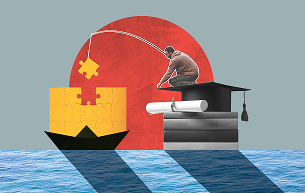

This page is about the Innovative Change-Maker: the leader who drives transformation through creative risk-taking, imaginative problem-solving, and adaptive vision. See all 20 personas →
About SynapseScope's framework
SynapseScope's leadership personas are proprietary behavioral archetypes, grounded in behavioral psychology and validated against assessment data from thousands of leaders. The framework identifies 20 distinct archetypes. Each one names the pattern that emerges when behavioral tendencies across eight dimensions combine into a recognizable leadership signature.
In 1998, Sara Blakely was selling fax machines for Danka in Atlanta and doing stand-up comedy on the side. She wanted to wear open-toed shoes with white pants and could not find shapewear that worked under them, so she cut the feet off a pair of pantyhose. The prototype worked. She had $5,000 in savings and no fashion-industry connections[10].
Over the next two years she developed the cut-off pantyhose into a real product, paid an attorney $750 to file the patent — a fraction of standard fees because she had drafted the technical claims herself — and started cold-calling department-store buyers. Most turned her down. When she got her shot at Neiman Marcus around 2000, she demonstrated the prototype to the buyer in the store's restroom. Neiman placed an order for seven stores. Spanx hit $4 million in revenue its first year and $10 million its second[10]. In 2012, Forbes named Blakely the youngest self-made female billionaire in the world[10].
The change Blakely made was not technological. It was a re-imagined product category nobody had thought to question. Pantyhose had existed in roughly the same form for decades. The bet was that the design space everyone treated as solved was actually wide open if you walked in without the conventions of the industry telling you which moves were not allowed.
Call them Innovative Change-Makers: leaders who pair adventurous risk-taking with imaginative creativity and strategic vision, who manufacture uncertainty rather than absorb it, and who tend to surface during the moments when others are still optimizing. Based on SynapseScope's leadership database (December 2025), Innovative Change-Makers represent approximately 4-6% of assessed leaders, and their impact tends to compound when paired with operators who can validate and execute.
The question is whether your team has someone willing to take bold creative leaps, and whether you are that person.
The Psychological Profile of an Innovative Change-Maker
Innovative Change-Makers often feel constrained by conventional thinking. If you are one, you've watched organizations defer breakthrough bets in favor of safer projects, and you've found yourself naming alternatives the room would rather not consider. The pattern that defines this profile is the willingness to pursue bold changes with strategic purpose, neither random risk nor abstract ideation, where adventurous risk-taking, imaginative problem-solving, visionary direction, and adaptive flexibility all show up together rather than in isolation.
The difference between an Innovative Change-Maker and a reckless contrarian is the visionary thread: a contrarian disrupts for its own sake, while the Change-Maker disrupts toward a transformational outcome they can articulate.
In strategy discussions, while colleagues analyze how to optimize what already exists, you tend to ask whether anyone has tried something different in the first place. The behavioral signature is a willingness to explore territory the team can't yet evaluate, which is also why the alternatives you generate sometimes outpace the room's ability to weigh them.
Clayton Christensen's The Innovator's Dilemma makes a related point[9]: incumbents typically fail not from a lack of competence but because risk-aversion locks them into incremental improvement, leaving the breakthrough work to outsiders willing to absorb early uncertainty. Innovative Change-Makers tend to be that internal counterweight when the conditions allow it.
The trade-off is rarely captured in the strategy literature: advocating for bold moves while colleagues want certainty is often a solo position, and watching a creative idea get diluted into a safe compromise tends to leave a residue. Risk-taking gets dismissed as irresponsible by people who treat playing safe as the neutral default, even when standing still is its own bet.
Why Every Leadership Team Needs This Perspective
An organization that perfectly executes its current strategy while the market transforms around it ends up safe, stable, and obsolete. Innovative Change-Makers supply the bold reframing the team rarely generates internally. The contribution is conditional: it compounds where leadership creates room for calculated risk and stalls where the same risk gets pre-vetoed by committee.
The Unique Value You Bring
Reframing the question, not optimizing the answer
When Reed Hastings at Netflix saw streaming technology emerging, he bet the company on a complete business model transformation rather than adding streaming as a feature on top of DVD-by-mail[1]. That bet carried Netflix from 7.48 million subscribers in 2007 to over 260 million by 2023[2], and incremental thinking would not have produced the same arc.
Treating constraints as design inputs
A limitation the rest of the team accepts as fixed tends to be the place an Innovative Change-Maker starts working. The behavioral move is to ask what the solution would look like if the constraint were not load-bearing, then design backward from there. The trade-off is that the alternatives generated are sometimes unworkable for reasons the room hasn't articulated yet, which is why this work pairs better with rigorous evaluation than with applause.
Experimenting before the evidence arrives
Breakthrough innovation typically requires acting before the data supports the action. Instead of waiting for certainty, this persona sets up small experiments, takes the early signals seriously, and adapts the route as it goes. The discipline is in shutting an experiment down quickly when it isn't producing learning, which is a different skill from running it boldly in the first place.
Situations Where Innovative Change-Makers Become Indispensable
1. Disruptive Innovation and Market Creation
When an industry faces disruption or an organization needs to open a new market, Innovative Change-Makers tend to be the leaders willing to lead the move rather than respond to it. The reframing of category boundaries is where the value lands.
Real impact: When Warby Parker entered eyewear in 2010, the founders did not simply sell cheaper glasses online. They restructured the model around a home try-on program, direct-to-consumer pricing at $95 against typical $300-plus retail prices, a paired social mission, and in-house design[3]. That set of moves disrupted a century-old industry dominated by Luxottica[3], and the company went public in 2021 with a roughly $6.1 billion valuation[4].
2. Breakthrough Product and Business Model Innovation
Organizations need this persona when incremental improvement isn't enough and an unproven concept is the right bet. The pattern is reimagining what the product is for, not enhancing what it already does.
Consider this: When Square (now Block) launched in 2009, Jack Dorsey reimagined payment processing rather than improving it[5]. A simple card reader that turned smartphones into payment terminals carried real risk and a real reframing of who the merchant could be. The company grew to over $200 billion in annual gross payment volume by 2023[6], a trajectory that started from a thesis no one had yet validated.
3. Organizational Transformation and Reinvention
When an organization needs fundamental reinvention rather than operational improvement, Innovative Change-Makers tend to drive it. The work involves challenging long-standing assumptions, exploring directions the team has avoided, and adjusting as the transformation unfolds.
Real impact: When Slack emerged from the failed gaming company Tiny Speck (Glitch) in 2013, the founders pivoted to an internal communication tool they had built for themselves and launched it into an uncertain enterprise market[7]. The pivot turned a failed game into a product that scaled rapidly and sold to Salesforce for $27.7 billion in 2021[8].
When This Persona Goes Wrong
The same orientation that produces breakthrough work, run without ballast, becomes the failure mode. Without analytical counterweight from Analytical Planners, Strategic Architects, or risk-averse colleagues who validate before committing, an Innovative Change-Maker can pursue bold ideas without the rigor that separates calculated risk from speculative one. You chase shiny innovations while the core business starves, and flexibility becomes drift.
The risk multiplies when every idea gets treated as breakthrough-worthy. Innovating broadly tends to crowd out deep execution; pivoting frequently tends to keep any one bet from gaining traction; the creative reflex sometimes dismisses a proven approach that the business actually needs. Sometimes the answer is finishing what's already started rather than launching the next experiment.
If "bold innovation is what organizations need to survive" feels like an unconditional truth, that conviction is itself a warning sign. The leaders who scale in this persona are usually the ones who can tell when the moment calls for breakthrough work and when it calls for disciplined execution of what's already in flight.
Creating Collaboration, Not Clash
Innovative Change-Makers tend to do their best work when paired with operators whose default mode is the opposite of theirs. The pairings below describe how that integration plays out in practice.
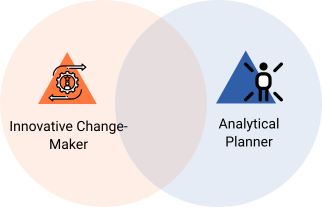
Innovative Change-Maker + Analytical Planner. Bold creative bets pressure-tested with analytical rigor, where the planner identifies which assumptions in the new idea need evidence before the resource commitment scales.
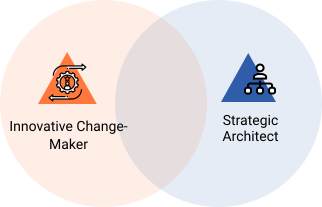
Innovative Change-Maker + Strategic Architect. Breakthrough moves attached to a longer-arc roadmap, so the bold reframing actually compounds inside the strategy rather than running parallel to it.
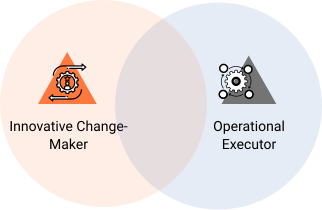
Innovative Change-Maker + Operational Executor. The pairing where an idea actually ships, because the executor translates the reframing into a sequence of deliverables that an operating team can complete.
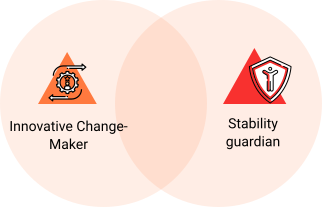
Innovative Change-Maker + Risk-Averse Leader. Bold experiments paired with realistic safeguards, where the risk-averse counterpart names the downside scenarios that the experiment design needs to account for.
When teams understand what each persona contributes, the differences become complementary. The bold creative work generates the breakthrough; colleagues validate, plan, and execute it into a result the business can sustain.
In closing
The Innovative Change-Maker isn't a leadership style to celebrate or correct. It's one of 20 patterns SynapseScope models. The fit between the pattern and the role — and the operators around the leader — determines whether the value compounds or the team burns out. Read about all 20 personas →
References & Sources
Research Foundations
- Keating, G. (2012). Netflixed: The Epic Battle for America's Eyeballs. New York: Portfolio/Penguin. Also documented in Harvard Business School Case Study 9-607-138 "Netflix" (2007). Cited for: Netflix's strategic transformation from DVD rental to streaming, representing Reed Hastings' bold decision to cannibalize the company's core business model to pursue transformational innovation.
- Netflix Inc. (2024). "Exhibit 99.1: Q4 2023 Letter to Shareholders." SEC EDGAR Filing. https://www.sec.gov/Archives/edgar/data/1065280/000106528024000029/ex991_q423.htm Cited for: Netflix subscriber growth from 7.48 million in 2007 to over 260 million by 2023, demonstrating the long-term impact of bold business model transformation.
- Harvard Business School. "Warby Parker: Vision of a 'Good Fashion' Brand." Case Study 9-513-051 (2013). https://www.hbs.edu/faculty/Pages/item.aspx?num=42908 Cited for: Warby Parker's disruptive innovation in eyewear through home try-on model, direct-to-consumer pricing ($95 vs $300+ traditional), and social mission (Buy a Pair, Give a Pair), disrupting Luxottica's industry dominance.
- Chang, A. (2021). "Warby Parker ends stock market debut with $6.1-billion market value." Los Angeles Times. https://www.latimes.com/business/story/2021-09-29/warby-parker-ends-debut-with-6-1-billion-market-value Cited for: Warby Parker's $6.1 billion valuation at 2021 IPO, validating the market impact of disruptive innovation.
- Lapowsky, I. (2013). "Jack Dorsey: The Man Who Made the Cash Register Obsolete." Inc. https://www.inc.com/audacious-companies/issie-lapowsky/square.html. Also documented in Harvard Business School Case Study 9-811-101 "Square: 2009" (2011). Cited for: Jack Dorsey's creative reimagination of payment processing through Square's smartphone card reader, transforming mobile devices into payment terminals.
- Block, Inc. (2024). "Q4 2023 Shareholder Letter." https://s29.q4cdn.com/628966176/files/doc_financials/2023/q4/Block-Inc-Q4-2023-Shareholder-Letter.pdf Cited for: Square's payment volume growth from $17.9 billion in 2012 to over $200 billion annually by 2023, demonstrating scalable impact of bold innovation.
- Levy, S. (2014). "The Full Story of How Slack Went From a Failed Game Studio to a $1.1 Billion Company." Backchannel (Medium). https://backchannel.com/the-full-story-of-how-slack-went-from-a-failed-game-studio-to-a-1-1-billion-company-7e80d6b0e0a Cited for: Slack's pivot from failed gaming company Tiny Speck (Glitch) to enterprise communication platform in 2013, exemplifying bold creative risk-taking that transformed failure into opportunity.
- Salesforce. (2021). "Salesforce Completes Acquisition of Slack." Official press release. https://www.salesforce.com/news/press-releases/2021/07/21/salesforce-slack-deal-close/ Cited for: Slack's $27.7 billion acquisition by Salesforce in 2021 and 8 million daily active users within five years, validating the value of bold pivots and creative risk-taking.
- Christensen, C. M. (1997). The Innovator's Dilemma: When New Technologies Cause Great Firms to Fail. Harvard Business School Press. Cited for: The pattern that incumbents typically fail not from a lack of competence but because risk-aversion locks them into incremental improvement, leaving the breakthrough work to outsiders willing to absorb early uncertainty.
- Sara Blakely & Spanx Inc. corporate biography (2000-2025); Forbes "World's Billionaires" (2012). Cited for: Sara Blakely's 1998 conception of Spanx while working at Danka selling fax machines in Atlanta; $5,000 starting capital; $750 patent-attorney fee on a self-drafted patent application; first Neiman Marcus order in seven stores around 2000; first-year revenue of $4 million and second-year revenue of $10 million; 2012 Forbes designation as the youngest self-made female billionaire in the world.
Case Examples Referenced
- Netflix/Reed Hastings - Used to illustrate revolutionary transformation over incremental optimization, demonstrating bold business model changes from DVD rental to streaming to content creation that redefined the entertainment industry.
- Warby Parker - Exemplifies disruptive market innovation through creative reimagination of eyewear distribution, pricing, and social mission that challenged century-old industry structures.
- Square/Jack Dorsey - Demonstrates breakthrough product innovation by creatively reimagining payment processing through simple smartphone-based solutions that democratized merchant payment acceptance.
- Slack (from Tiny Speck/Glitch) - Illustrates organizational transformation through bold pivots, showing how creative risk-taking can transform failure into multi-billion dollar success by reimagining internal tools as market products.
Assessment Methodology
SynapseScope Leadership Assessment identifies Innovative Change-Makers through behavioral patterns including high risk-taking orientation (adventurous, bold opportunity-seeking), high creative drive (imaginative, innovative thinking), strategic vision (long-term thinking with practical steps), and adaptive flexibility. Prevalence statistics derived from proprietary database (December 2025). For technical documentation, see the science behind the assessment.
Discover Your Leadership Persona
Every organization needs all 20 leadership personas to thrive. Innovative Change-Makers are one essential piece, incomplete without the others.
Where do you fit in your organization's leadership ecosystem?