

This page is about the Operational Executor: the leader who turns strategic plans into operational reality through systematic process discipline and reliable execution. See all 20 personas →
About SynapseScope's framework
SynapseScope's leadership personas are proprietary behavioral archetypes, grounded in behavioral psychology and validated against assessment data from thousands of leaders. The framework identifies 20 distinct archetypes. Each one names the pattern that emerges when behavioral tendencies across eight dimensions combine into a recognizable leadership signature.
On October 15, 2011, monsoon flooding submerged Thailand's industrial estates and drowned the factories that produced roughly 25% of the world's hard drives[5]. Western Digital lost two facilities. Q4 2011 shipments fell to 28.5 million drives from 52.2 million the prior-year quarter — almost half the company's output, gone in a week.
Western Digital had its first production line back online about 46 days later, by salvaging waterlogged equipment, decontaminating clean rooms, and rebuilding inside a country that was still flooded[5]. Hard drive prices nearly doubled globally and didn't return to pre-flood levels until April 2013. Western Digital reported a 31% revenue increase and more than doubled fiscal 2012 profits. The operational recovery captured market share that competitors couldn't match.
What carried the recovery wasn't strategy. It was the people inside Western Digital who knew how the production line worked at a component level, knew which clean-room procedures could be improvised and which couldn't, and knew how to coordinate decontamination, equipment salvage, and supplier re-sourcing in parallel rather than in sequence. Strategy decided to rebuild. Operations made the rebuild possible.
These are Operational Executors: leaders who build systems that turn chaos into repeatable delivery. While others get excited about possibilities, they are mapping the path from here to there. Based on SynapseScope's leadership database (December 2025), Operational Executors represent approximately 12% of assessed leaders, and their presence is the difference between strategies that inspire presentations and strategies that create actual business value.
The question is: Do you have enough people who can actually make things happen, and are you one of them?
The Psychological Profile of an Operational Executor
Operational Executors often feel underappreciated in a business world that celebrates "visionaries" and "innovators." If you're one, you've sat through meetings where "tactical" was used to dismiss the only person in the room thinking about delivery week one.
From a behavioral psychology perspective, the profile clusters around four traits:
- Process-first thinking and a bias toward systematizing what others leave implicit
- Cautious about risk, with a preference for stability and controlled rollout
- Reliable to a fault, with strong follow-through on commitments
- Execution focus that treats delivery, not deliberation, as the proof point
The Operational Executor combines execution focus with process-centric discipline and a careful, risk-averse stance. The leader translates plans into milestone-driven workflows, holds the line on quality and reliability when shortcuts tempt the team, and engineers systems that survive transitions and scale beyond their author. The result is operational excellence through streamlined processes, reliable delivery against deadlines, and consistent performance standards.
Satisfaction here doesn't come from imagining possibilities. It comes from a project crossing the finish line on time, in scope, and at quality. That's where the deepest professional fulfillment lands.
The basal ganglia and dorsolateral prefrontal cortex handle habit formation and goal-directed planning[1][2]. The neuroimaging work specific to Operational Executors hasn't been done; what we have is their self-reports, which describe how those systems feel from the inside: workflows surface visibly, bottlenecks register as friction, process inefficiencies that others overlook show up as obstacles to delivery.
The cost of that wiring is real. Meetings that prioritize "big picture thinking" over execution realities feel dismissive. Watching strong ideas fail because no one built the operational foundation to support them grates. Process improvements get filed under "not strategic enough," even when reliability at scale is itself a strategic asset.
The Unique Value You Bring
Where peers see a launch, you see a workflow.
That new product launch everyone is excited about reads as an operational map: workflow, failure modes, contingency. The intent is not to dampen enthusiasm but to give it scaffolding strong enough to ship.
Process discipline reads as bureaucracy until a competitor's quality collapses.
Amazon's fulfillment reliability is widely cited as a competitive moat, built on a fulfillment-network strategy of locating centers closer to customers and continuously optimizing throughput[3]. The work that produces that consistency isn't glamorous, but it's the substrate of the company's retail dominance.
Speed without scaffolding is debt.
Moving fast and breaking things works until it doesn't. Processes that scale, survive leadership transitions, and deliver consistent quality even when key people leave are how organizational resilience gets built.
Situations Where Operational Executors Become Indispensable
1. Scaling Operations and Growth
When organizations grow from 50 to 500 or 500 to 5,000 people, informal processes break down. Operational Executors thrive in this chaos by systematizing operations that can scale.
Real impact: Scaling from a small marketplace to a global platform of millions of listings forces verification, onboarding, and quality systems to be rebuilt from the ground up. Airbnb is the canonical example: the operations work that kept quality from collapsing under exponential growth was the unglamorous half of the company's rise[4].
2. Crisis Management and Operational Recovery
When things go wrong, whether product recalls, supply chain failures, or system outages, organizations need Operational Executors who can stabilize operations under pressure.
Consider this: The 2011 Thailand floods disrupted global hard drive supply for months, with major manufacturers losing roughly half of quarterly shipments and facing a multi-month recovery timeline[5]. Operations leaders at affected manufacturers improvised equipment salvage, rebuilt damaged facilities at speed, and worked to maintain delivery commitments through coordinated crisis response.
3. Regulatory Compliance and Quality Assurance
In highly regulated industries (healthcare, finance, aerospace), operational excellence isn't optional, it's existential. Operational Executors ensure organizations meet standards consistently.
Real impact: In pharmaceutical manufacturing, deviation can mean product recalls, regulatory sanctions, or patient harm. Operational Executors design and maintain the processes where that line holds.
4. Turning Around Underperforming Operations
When departments miss deadlines, quality suffers, or costs spiral out of control, Operational Executors diagnose operational breakdowns and rebuild functional processes.
Target's Canadian expansion is the case in point. Whatever the strategic flaws, the operational layer collapsed: inventory management, distribution, and process discipline failed in sequence[6]. An Operational Executor in the loop earlier would have flagged the failures while they were still fixable.
When This Persona Goes Wrong
Here's the hard truth: a great strength, overexpressed, becomes a liability.
Without balance from Visionary Innovators, Strategic Architects, or Innovative Change-Makers, Operational Executors can optimize processes that should be eliminated entirely. You perfect the execution of yesterday's strategy while competitors redefine the game. Your teams become brilliant at delivering the wrong things efficiently.
The risk multiplies when necessary innovation gets blocked because it doesn't fit existing processes. Not every problem should be solved by refining current operations. Sometimes the process itself needs to be reimagined, even if that creates temporary inefficiency. When process adherence outranks outcome achievement, execution excellence has crossed into bureaucratic rigidity.
If you're reading this and thinking "but the process is there for a reason, people just won't follow it," that might be exactly the warning sign. The best Operational Executors know when to follow the process, when to improve it, and when to throw it out entirely.
Creating Collaboration, Not Clash
Understanding how Operational Executors work with others transforms friction into breakthrough:
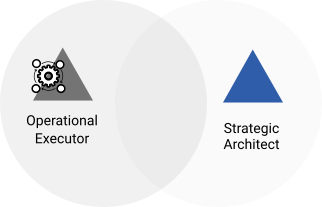
Operational Executor + Strategic Architect = Long-term plans with operational roadmaps that deliver.
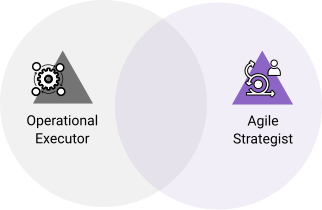
Operational Executor + Agile Strategist = Flexibility within structured frameworks for rapid adaptation.
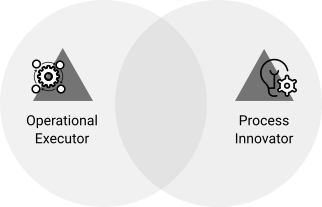
Operational Executor + Process Innovator = Operational excellence through continuous process innovation.
When teams understand each persona's value, differences become complementary. Execution discipline provides a foundation, when paired with leaders who set direction and revisit it; on its own, it locks in yesterday's plan.
In closing
The Operational Executor isn't a leadership style to celebrate or correct. It's one of 20 patterns SynapseScope models. The fit between the pattern and the role — and the operators around the leader — determines whether the value compounds or the team burns out. Read about all 20 personas →
References & Sources
Research Foundations
- Graybiel, A. M. (2008). Habits, rituals, and the evaluative brain. Annual Review of Neuroscience, 31, 359-387. Cited for: Research on basal ganglia's role in procedural learning and habit formation.
- Miller, E. K., & Cohen, J. D. (2001). An integrative theory of prefrontal cortex function. Annual Review of Neuroscience, 24, 167-202. Cited for: Research on prefrontal cortex and goal-directed behavior, planning, and executive control.
- Stone, B. (2013). The Everything Store: Jeff Bezos and the Age of Amazon. Little, Brown and Company. Cited for: Documentation of Amazon's fulfillment-network strategy — building centers closer to major cities, applying Six Sigma and lean-manufacturing methods to optimize throughput, and treating fulfillment infrastructure as a core competitive moat in the company's retail dominance.
- Gallagher, L. (2017). The Airbnb Story: How Three Ordinary Guys Disrupted an Industry, Made Billions . . . and Created Plenty of Controversy. Houghton Mifflin Harcourt. Cited for: Investigative account of Airbnb's scaling from a niche marketplace to global platform — including the host-verification, trust, and quality-system rebuilds required as bookings scaled into the tens of millions of guest arrivals by 2016.
- Fuller, T. (2011, December 6). Thailand flooding cripples hard-drive suppliers. The New York Times. See also: Hutchinson, L. (2012). The lessons of Thailand's flood. IEEE Spectrum. Cited for: Documentation of the 2011 Thailand floods' impact on global HDD supply — Western Digital shipped 28.5 million drives in Q4 2011 versus 52.2 million the prior-year quarter, with multi-month recovery timelines and on-site improvisation (equipment salvage, facility decontamination) as the operational response that restored production within 46 days for WD's first restored line.
- Castaldo, J. (2016, January 21). The Last Days of Target Canada. Canadian Business. Cited for: The canonical post-mortem on Target Canada's collapse — covering the SAP inventory-system failures, distribution-center misalignment, and operational breakdowns in moving product from distribution centers onto store shelves that drove the Canadian segment exit.
Assessment Methodology
SynapseScope Leadership Assessment measures behavioral patterns across 8 dimensions using validated psychometric principles. Prevalence statistics derived from proprietary leadership database (December 2025). For technical documentation on the Spectrum Foundation framework, see the science behind the assessment.
Discover Your Leadership Persona
Every organization needs all 20 leadership personas to thrive. Operational Executors are just one piece — essential, but incomplete without the others.
Where do you fit in your organization's leadership ecosystem?