
This page is about the Relationship Builder: the leader who treats trust networks as strategic infrastructure, building the relationship ecosystems that turn long-horizon vision into collective capability. See all 20 personas →
About SynapseScope's framework
SynapseScope's leadership personas are proprietary behavioral archetypes, grounded in behavioral psychology and validated against assessment data from thousands of leaders. The framework identifies 20 distinct archetypes. Each one names the pattern that emerges when behavioral tendencies across eight dimensions combine into a recognizable leadership signature.
Enron was celebrated as America's most innovative company. It had visionary leadership, aggressive strategy, and smart people. By 2001, it had collapsed in the largest bankruptcy in American history at the time[1].
Enron's relationships were purely transactional. Partnerships existed to extract value. Employees were ranked and culled. Suppliers were squeezed. When trouble emerged, there was no relationship capital to draw on: partners fled, employees turned whistleblower, the company collapsed[1].
Costco took a different path. Jim Sinegal built the company on strategic relationship infrastructure[2]. Employee relationships were investments: wages above industry average, real career development, low turnover. Supplier relationships ran on fair terms and long-term commitments. Customers paid for membership, not transactions.
Both companies had ambitious visions. One built relationship infrastructure to support transformation. One treated relationships as expendable.
The difference wasn't networking skill. It was whether leadership combined long-term strategic vision with genuine investment in people, building the relationship ecosystems that turn individual capability into collective output that lasts.
These are Relationship Builders: leaders who see connection not as networking tactics but as strategic infrastructure. They imagine transformational futures AND build the authentic human relationships required to achieve them.
Your strategists design transformation on paper. Without a trust network aligned to that vision, the plan has no human conduit to execute it.
You need someone who thinks in decades, invests genuinely, and treats each relationship as both connection and capability.
About 4% of leaders in our database show this profile[3]. The scarcity reflects the difficulty of holding two cognitive modes (strategic patience and interpersonal investment) at once; the typical leader specializes in one and outsources the other.
The question is: Do you have one building your organization's trust networks — and are you that person?
The Psychological Profile of a Relationship Builder
Relationship Builders sit between strategists and people-focused leaders, and the position has costs. Strategists discount the relational work as soft. Networkers find the strategic patience slow. The middle position is real, and it compounds in organizations that reward long-horizon investment, while it gets dismissed in those that don't.
On the SynapseScope assessment, this profile combines high Visionary Orientation (strategic, long-term), intense People Focus (empathetic, trust-building), Customer-Centric Approach, and Growth Orientation.
Relationships are neither pursued for their own sake nor treated as separate from strategy. You see them as strategic infrastructure: the trust and ecosystems that turn long-term vision into execution.
Your mind works differently in strategic discussions. While pure strategists analyze market dynamics and pure people-focused leaders think about team wellbeing, you're mapping relationship ecosystems: who needs to connect with whom, what trust needs to be built, which partnerships could create transformational possibilities. You see organizational capability emerging from relationship networks, not just from structures and processes.
The difference between a Relationship Builder and a tactical networker is the visionary thread; a networker collects contacts, while the Relationship Builder builds those contacts into an ecosystem aimed at a long-term outcome.
When a leader has trusted relationships across groups that don't normally talk to each other — engineering and sales, finance and operations, HQ and the field — they see things first[4]. Information that would otherwise bounce through three meetings reaches them in one conversation. That's the Relationship Builder's edge: the cross-group connections that other leaders never built.
Relationship Builders often describe quarterly performance reviews as poorly fit to multi-year partnership work, and value executive-development time. The pattern shows up early: a brilliant strategy fails because no one invested in the relationships needed to execute it, and the relational work that would have prevented it gets dismissed as "just networking."
Why Every Leadership Team Needs This Perspective
Organizations with brilliant strategy, strong operations, and talented people still lose deals when trust networks are thin. Partnerships collapse on missing trust, not poor economics. Cross-functional work stalls on absent relationships. Customer retention erodes when interactions stay transactional. Few organizations invest in this layer.
Relationship Builders provide what few others can: the capacity to build strategic relationship ecosystems that create trust, collaboration, and collective capability beyond what any single organization or function could achieve alone.
The Unique Value You Bring
When others network tactically, you build relationship ecosystems strategically.
LinkedIn is the obvious example: a database of contacts that became, by design, the place professionals go to find each other. Reid Hoffman built it as connective infrastructure rather than a contact list, and that distinction is the one Relationship Builders make instinctively[5].
Bridges across boundaries.
When cross-functional initiatives stall on missing relationships rather than unclear goals, alignment workshops won't fix it. What works is facilitating connections between individuals and building trust through shared experience until collaboration becomes natural rather than forced.
Partnerships held by relationship, not contract.
Strong partnerships outlast their contracts because the relationship, not the document, sustains them. Investing in those human connections is what makes partnerships resilient and generative when conditions change.
Situations Where Relationship Builders Become Indispensable
1. Strategic Partnerships and Alliance Development
When organizations pursue partnerships, acquisitions, or strategic alliances, Relationship Builders create the human foundation that makes them work. The work isn't just negotiating terms; it's building authentic relationships between leaders, creating trust across organizations, and fostering the collaborative culture that turns agreements into actual value creation.
Real impact: When Disney acquired Pixar in 2006, both Catmull and Iger document the deliberate work of preserving Pixar's culture through relationships rather than reorganization[6]. We read that as Relationship-Builder work in practice, and the acquisition succeeded on that relationship architecture, not just the financial terms.
2. Customer Relationship Strategy and Retention
Organizations need Relationship Builders to transform customer relationships from transactional accounts into strategic partnerships. Beyond managing accounts, the work is building authentic relationships with customer stakeholders, understanding their long-term vision, and creating collaborative partnerships that benefit both organizations over time.
Consider this: Salesforce retains long-tenured enterprise customers not because Salesforce wins on every product feature, but because the account relationships have outlived the product gaps. Genuine care, strategic alignment, and collaborative growth turn customers into partners invested in mutual success.
3. Cross-Functional Collaboration and Matrix Organizations
When organizations need collaboration across silos, geographies, or functions, Relationship Builders create the connection infrastructure. Beyond aligning on objectives, the work is building authentic relationships between people, creating informal networks that transcend org charts, and fostering the trust that makes collaboration work despite structural complexity.
Real impact: In matrix organizations where people report to multiple leaders across functions and regions, Relationship Builders create the social capital that makes the structure work, building relationships that let people navigate complexity through trust and authentic connection rather than just formal authority.
4. Building Ecosystem and Platform Strategies
When organizations pursue ecosystem or platform strategies, creating value through networks of partners, customers, and developers, Relationship Builders architect the connective layer. They build communities, foster collaboration among ecosystem participants, and create the trust and shared vision that turns individual actors into collaborative ecosystems.
Salesforce built its ecosystem through relationship architects who run AppExchange partner programs, Trailblazer community events, and Dreamforce[7]. The platform mattered, but the social infrastructure is what made the ecosystem generative rather than just transactional.
When This Persona Goes Wrong
Your greatest strength, overexpressed, becomes your greatest weakness.
Without balance from other personas, particularly Results-Driven Executors, Strategic Architects, or Directive Leaders who maintain performance standards and strategic discipline, Relationship Builders can invest so deeply in relationships that accountability suffers. You prioritize harmony over necessary difficult conversations. You maintain relationships with partners or customers who aren't delivering value. Your focus on long-term relationship-building delays necessary short-term decisions.
The risk multiplies when relationship-building becomes an end rather than a means. Sometimes the most strategic move isn't another relationship-building conversation; it's clear standards, honest assessment, and willingness to end relationships that aren't serving organizational needs.
If you're reading this and thinking "but relationships ARE the strategy, others just don't value them enough," that is exactly the warning sign. The best Relationship Builders know that authentic relationships serve strategic purpose, and strategic purpose gives relationships direction.
Creating Collaboration, Not Clash
Understanding how Relationship Builders work with others transforms friction into breakthrough:
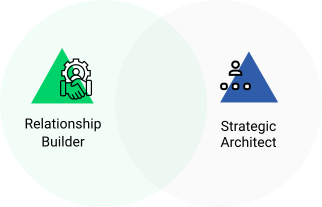
Relationship Builder + Visionary Innovator = Strategic vision grounded in relationship ecosystems; imagination meets connection infrastructure.
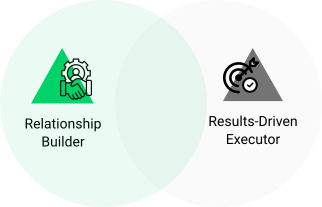
Relationship Builder + Strategic Architect = Strategic roadmaps enriched by relationship networks; planning enhanced by social capital.
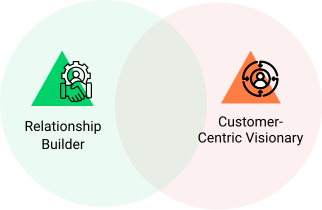
Relationship Builder + Results-Driven Executor = Relationship infrastructure that delivers results; connection meets execution.
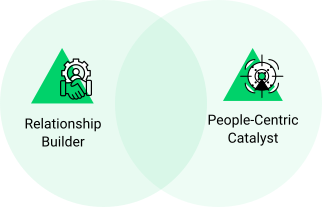
Relationship Builder + People-Centric Leader = Internal and external relationship excellence; team relationships and strategic partnerships.
When teams understand each persona's value, differences become complementary. The trust networks you build are what give strategic vision a chance of landing as collaborative reality.
In closing
The Relationship Builder isn't a leadership style to celebrate or correct. It's one of 20 patterns SynapseScope models. The fit between the pattern and the role — and the operators around the leader — determines whether the value compounds or the team burns out. Read about all 20 personas →
References & Sources
Research Foundations
- McLean, B., & Elkind, P. (2003). The Smartest Guys in the Room: The Amazing Rise and Scandalous Fall of Enron. New York: Portfolio. Cited for: Enron's collapse in 2001 as the largest bankruptcy in American history at that time, resulting from a purely transactional relationship culture where partnerships existed to extract value, employees were ranked and culled, and suppliers were squeezed, leaving no relationship capital when trouble emerged.
- Holmes, S., & Zellner, W. (2004). "The Costco Way: Higher wages mean higher profits. But try telling Wall Street." BusinessWeek, April 12, 2004. Also documented in Cascio, W. F. (2006). "Decency Means More than 'Always Low Prices': A Comparison of Costco to Wal-Mart's Sam's Club." Academy of Management Perspectives, 20(3), 26-37. Cited for: Jim Sinegal's strategic relationship infrastructure at Costco, including employee relationships as investments (wages above industry average, genuine career development, low turnover), supplier relationships as partnerships (fair terms, long-term commitments, mutual growth), and customer relationships as authentic belonging rather than transactions.
- Based on SynapseScope's leadership database (December 2025), Relationship Builders represent approximately 4% of assessed leaders across multiple industries and organizational levels. Cited for: Prevalence estimate for leaders combining high Visionary Orientation (strategic thinking, long-term vision) with high People Focus (relationship-centered, trust-building), Customer-Centric Approach, and Growth Orientation.
- Burt, R. S. (1992). Structural Holes: The Social Structure of Competition. Cambridge, MA: Harvard University Press. Also Cohen, D., & Prusak, L. (2001). In Good Company: How Social Capital Makes Organizations Work. Boston: Harvard Business School Press. Cited for: Research on social capital and network effects demonstrating that organizations with strong relationship ecosystems built on authentic trust, strategic connection, and genuine care outperform those with equivalent resources but weaker relationship infrastructure.
- Hoffman, R., & Casnocha, B. (2012). The Start-up of You: Adapt to the Future, Invest in Yourself, and Transform Your Career. New York: Crown Business. Also documented in Lashinsky, A. (2012). "LinkedIn: How it changed business networking." Fortune, July 1, 2012. Cited for: Reid Hoffman's creation of LinkedIn as a strategic relationship ecosystem that transformed how professionals connect, collaborate, and create value together, representing relationship infrastructure rather than just a database of contacts.
- Catmull, E., & Wallace, A. (2014). Creativity, Inc.: Overcoming the Unseen Forces That Stand in the Way of True Inspiration. New York: Random House. Also Iger, R. (2019). The Ride of a Lifetime: Lessons Learned from 15 Years as CEO of the Walt Disney Company. New York: Random House. Cited for: Disney's $7.4 billion acquisition of Pixar in 2006, which succeeded through authentic relationship-building between creative teams, leadership, and cultures on both sides, creating relationship infrastructure that preserved Pixar's innovation culture while enabling Disney's distribution power.
- Benioff, M., & Adler, C. (2009). Behind the Cloud: The Untold Story of How Salesforce.com Went from Idea to Billion-Dollar Company and Revolutionized an Industry. San Francisco: Jossey-Bass. Cited for: Salesforce's ecosystem-building strategy organized around the AppExchange partner marketplace (launched 2005), Trailblazer community programs, and the annual Dreamforce conference (first held in 2003), through which the company built the social infrastructure that turned its platform into a generative partner-and-customer ecosystem.
Assessment Methodology
SynapseScope's Leadership Assessment identifies Relationship Builders through behavioral patterns across eight dimensions. This persona combines high Visionary Orientation (strategic thinking, long-term focus, forward-looking), high People Focus (relationship-centered, empathetic, trust-building), Customer-Centric Approach (stakeholder relationships, client partnerships), and Growth Orientation (empowerment, development focus). Prevalence statistics derived from SynapseScope's leadership database (December 2025). For technical documentation on assessment methodology and validation, see the science behind the assessment.
Discover Your Leadership Persona
Relationship Builders are just one piece, essential but incomplete without the others.
Where do you fit in your organization's leadership ecosystem?