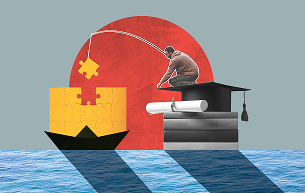

This page is about the Adaptive Achiever: the leader who pivots tactically as conditions shift while holding the goal steady through the redesign. See all 20 personas →
About SynapseScope's framework
SynapseScope's leadership personas are proprietary behavioral archetypes, grounded in behavioral psychology and validated against assessment data from thousands of leaders. The framework identifies 20 distinct archetypes. Each one names the pattern that emerges when behavioral tendencies across eight dimensions combine into a recognizable leadership signature.
Kodak invented the digital camera in 1975[1]. By 2012, it filed for bankruptcy with $6.75 billion in debt[2]. Fujifilm faced the same digital disruption. Today, it's thriving with over $20 billion in annual revenue[3].
Both companies had five-year strategic plans. Kodak's plan doubled down on film while gradually exploring digital. They executed it flawlessly: protecting film margins, developing digital cameras, acquiring photo-sharing sites. The strategy was coherent and the execution disciplined. It led straight to bankruptcy[4].
Fujifilm took a different path. It maintained strategic intent (a stated commitment to thrive in a post-film world) while adapting tactics constantly[3]. When one approach didn't work, the company pivoted, moving into cosmetics, pharmaceuticals, medical imaging, and advanced materials, testing and adjusting based on what worked[3].
The difference wasn't vision. Both companies saw digital coming. The difference was adaptive capacity: the ability to hold long-term direction steady while redesigning the path as conditions changed[4].
These are Adaptive Achievers: leaders who combine moderate visionary orientation with strong flexibility and goal-driven execution.
The question isn't whether your organization needs this capability. It's whether you can identify who has it, and whether you're that person.
The Psychological Profile of an Adaptive Achiever
Adaptive Achievers often feel caught between worlds. Visionaries label your tactical adjustments as lack of conviction; execution operators label your forward-thinking as overthinking.
The signature appears across three patterns:
- Moderate Visionary Orientation (predominantly visionary with practical task orientation)
- Strong Flexibility (predominantly flexible with reliability)
- Balanced Risk Approach (thoughtful consideration with openness to opportunities)
The Adaptive Achiever combines flexibility with visionary direction-setting and a willingness to commit to calculated risk. The leader adapts as conditions evolve, holds the goal steady through the redesign, and accepts measured exposure to drive movement when waiting would cost more than acting. The result is organizational agility that responds to market change without losing strategic focus on core objectives.
In fast-changing markets, leaders who adjust their plans tend to outperform leaders who hold rigidly to one[5]. The same adaptive style shows up alongside stronger innovation results: teams produce more new ideas and ship more new products under adaptive leaders[6].
Why Every Leadership Team Needs This Perspective
Sears stuck to its retail playbook through multiple leadership transitions. WeWork pivoted its core thesis repeatedly. Both ended at the same destination. Rigid planning and reactive pivoting fail in opposite directions, but they fail.
Adaptive Achievers provide what few others can: the ability to hold long-term direction steady while redesigning the path based on emerging realities, evaluating risks thoughtfully while pursuing ambitious goals.
The Unique Value You Bring
When others see planning and adjustment as opposites, you integrate both.
When Satya Nadella shifted Microsoft from Windows-focused to cloud-first, the destination (cloud leadership) stayed fixed while approaches, partnerships, and priorities were redesigned as opportunities emerged. Held alongside Nadella's seven-year tenure and a multi-billion-dollar Azure investment, that combination produced Microsoft's transformation[7].
When others stick to plans or abandon them, you adjust intelligently.
Stewart Butterfield's team abandoned the game Glitch in 2012 and rebuilt their internal chat tool as the product that became Slack[8]. The behavior worth attention is the willingness to drop a finished product and ship the side effect instead.
When others see calculated risk as timidity, you see it as wisdom.
In the framework, leaders who treat risk as something to study rather than something to bet on tend to adjust faster when the results come in: they decide up front what would change their mind, then change it when those signals arrive. Your balanced approach holds achievement steady when paired with execution partners who track results and report what actually happened.
Situations Where Adaptive Achievers Become Indispensable
1. Navigating Market Shifts and Disruption
Real impact: When Shantanu Narayen shifted Adobe from packaged software to cloud subscriptions in 2013, the core objective (creative software leadership) stayed fixed while the business model, pricing structure, and customer relationship were redesigned around recurring revenue[9].
2. Scaling Operations Through Growth
When organizations scale rapidly, Adaptive Achievers maintain clear direction while adapting structures and processes to keep operational coherence intact.
Consider this: Salesforce held its core aim (customer success through cloud software) steady while redesigning sales, partnership, and product motion vertical by vertical as it scaled into new markets[10].
When This Persona Goes Wrong
Here's the hard truth: your greatest strength, overexpressed, becomes your greatest weakness.
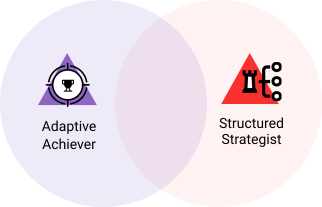
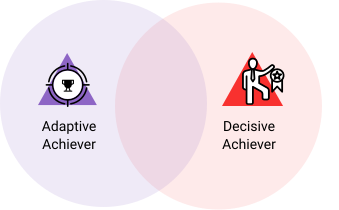
Without balance from Strategic Architects, Structured Strategists, or Decisive Achievers, Adaptive Achievers can adjust so continuously that direction dissolves and the team stops trusting any path you set. The same agility that enables responsiveness crowds out the deep thinking transformational breakthroughs require, and the answer is occasionally not more thoughtful adjustment but committing boldly to one path despite uncertainty.
If you're reading this and thinking "but complexity DOES require both clarity and nimbleness," that may be the warning sign. The best Adaptive Achievers can tell when balanced adjustment enables success and when it prevents the commitment a breakthrough requires.
Creating Collaboration, Not Clash
Understanding how Adaptive Achievers pair with other personas reduces friction in mixed teams.
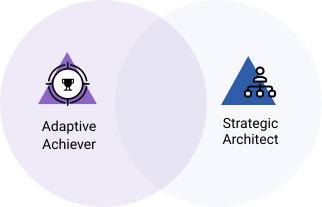
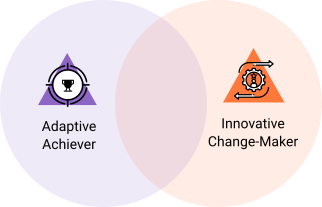
Adaptive Achiever + Strategic Architect = Deep long-term thinking executed adaptively, planning that flexes with reality.
In closing
The Adaptive Achiever isn't a leadership style to celebrate or correct. It's one of 20 patterns SynapseScope models. The fit between the pattern and the role — and the operators around the leader — determines whether the value compounds or the team burns out. Read about all 20 personas →
References & Sources
Research Foundations
- Sasson, S. (2007). We had no idea: An engineer's account of inventing the digital camera. Proceedings of the IEEE, 95(7), 1595-1596. Cited for: Steve Sasson's invention of the digital camera at Kodak in 1975.
- Mui, C. (2012). How Kodak failed. Forbes, January 18, 2012. Cited for: Kodak's 2012 bankruptcy filing with $6.75 billion in debt.
- Komori, S. (2015). Innovating Out of Crisis: How Fujifilm Survived (and Thrived) as Its Core Business Was Vanishing. Stone Bridge Press. Cited for: Fujifilm's strategic transformation including diversification into cosmetics, pharmaceuticals, medical imaging, and advanced materials with current revenues exceeding $20 billion.
- Lucas, H. C., & Goh, J. M. (2009). Disruptive technology: How Kodak missed the digital photography revolution. The Journal of Strategic Information Systems, 18(1), 46-55. Cited for: Analysis of adaptive capacity differences between Kodak and Fujifilm in responding to digital disruption.
- Uhl-Bien, M., & Arena, M. (2018). Leadership for organizational adaptability: A theoretical synthesis and integrative framework. The Leadership Quarterly, 29(1), 89-104. Cited for: Research showing that leaders who balance long-term direction with tactical agility outperform both rigid planners and reactive improvisers in dynamic environments.
- Yukl, G., & Mahsud, R. (2010). Why flexible and adaptive leadership is essential. Consulting Psychology Journal: Practice and Research, 62(2), 81-93. Cited for: Research on how organizational adaptability correlates with innovation, competitive positioning, and sustained performance.
Case Examples Referenced
- Microsoft's Cloud Transformation: Nadella, S. (2017). Hit Refresh: The Quest to Rediscover Microsoft's Soul and Imagine a Better Future for Everyone. Harper Business. Cited for: Satya Nadella's cloud-first reorientation of Microsoft and the multi-year Azure investment that anchored the transformation.
- Slack's Pivot: Butterfield, S. (2014). We don't sell saddles here. Internal memo. Medium, December 17, 2014. Cited for: Tiny Speck's pivot from the game Glitch (shut down December 2012) to the team-communication tool that became Slack.
- Adobe's Subscription Model: Narayen, S. (2013). Adobe's digital media shift. Harvard Business Review, November 2013. Cited for: Adobe's 2013 transition under CEO Shantanu Narayen from packaged Creative Suite to the Creative Cloud subscription model.
- Salesforce Multi-Market Expansion: Benioff, M., & Langley, M. (2019). Trailblazer: The Power of Business as the Greatest Platform for Change. Currency. Cited for: Salesforce's vertical-by-vertical expansion of its customer-success cloud platform while holding the core mission fixed.
Assessment Methodology
SynapseScope Leadership Assessment measures behavioral patterns across 8 dimensions using validated psychometric principles. Adaptive Achievers represent a distinctive profile combining moderate visionary orientation with strong flexibility and goal-driven execution. For technical documentation, see the science behind the assessment.
Discover Your Leadership Persona
Every organization needs all 20 leadership personas to thrive. Adaptive Achievers are one piece, essential but incomplete without the others.
Where do you fit in your organization's leadership ecosystem?