

This page is about the Decisive Achiever: the leader who provides clear direction and drives execution when paralysis-by-discussion is the failure mode. See all 20 personas →
About SynapseScope's framework
SynapseScope's leadership personas are proprietary behavioral archetypes, grounded in behavioral psychology and validated against assessment data from thousands of leaders. The framework identifies 20 distinct archetypes. Each one names the pattern that emerges when behavioral tendencies across eight dimensions combine into a recognizable leadership signature.
In October 2006, Indra Nooyi took over as CEO of PepsiCo and announced "Performance with Purpose": a strategy committing the company to migrate its portfolio toward healthier products even as Wall Street demanded short-term focus on flagship sodas and snacks[10]. The bet wasn't to a quarter; it was to a decade.
Nooyi held the line through twelve years of analyst skepticism. She kept investing in healthier brands while protecting the cash cows. She acquired what fit the long-term portfolio and divested what didn't. By the time she stepped down in August 2018, PepsiCo's annual net profit had grown from $2.7 billion to $6.5 billion, and the strategy she announced had become the consumer-packaged-goods industry blueprint[10].
Decisive doesn't always mean fast. Sometimes it means committing to a ten-year direction in a quarterly-earnings world and not flinching when the quarterly numbers wobble. The decisive call was the public commitment to a strategy that wouldn't show its full P&L impact for a decade. Everything after was execution.
These are Decisive Achievers: leaders who execute with precision, provide structured direction without hesitation, and drive toward goals with directness that ends ambiguity. Based on SynapseScope's leadership database (December 2025), Decisive Achievers represent a small minority of assessed leaders, but their impact is disproportionate. When execution outweighs exploration, this is the leadership that delivers.
The question is: Do you have someone who can cut through the noise and drive decisive action? Are you that person?
The Psychological Profile of a Decisive Achiever
Decisive Achievers often feel frustrated by endless deliberation. If you're one, you've probably experienced that particular impatience when teams debate options you've already analyzed and decided. You see clarity where others see complexity requiring more discussion, and you're ready to act while others want more input.
From a behavioral psychology perspective, you represent a distinctive and often undervalued profile:
- High Execution Focus (task-oriented, detail-oriented, precision-driven reliability)
- High Directive Orientation (structured, prescriptive, provides clear expectations)
- Strong Goal Orientation (primarily results-driven, achieves objectives efficiently)
The Decisive Achiever combines execution focus with directive clarity and goal-oriented commitment. The leader makes clear calls without waiting for unanimous agreement, sets specific deliverables with named owners and deadlines, and holds the line on the outcome that matters when others want to keep talking. The result is decisive action that converts ambiguity into accountable execution. The difference between a Decisive Achiever and an autocratic enforcer is the goal anchor; an enforcer issues directives without aligning them to the outcome that matters.
Your mind works differently in ambiguous situations. While others gather more data or seek more perspectives, you're already deciding the best path forward and directing execution. You trust your judgment, provide clear instructions, and hold people accountable for delivery. The cost is real: your team has fewer mechanisms to flag a miscalibrated call, because your directness discourages pushback.
Decisiveness shows up as one of the core constructs of effective crisis leadership in the empirical literature[1][2]. The relationship is correlational rather than causal, but it's consistent across the cases that have been examined.
You see execution paths where others see only questions, and that gap shows up as the gap between the leader who has already chosen and the room that hasn't.
The Unique Value You Bring
Speed substitutes for certainty.
In the early 1970s, FedEx founder Fred Smith flew to Las Vegas with the company's last $5,000 and won $27,000 at blackjack to cover the next $24,000 fuel bill, a decision he made alone, in hours, when the alternative was bankruptcy[5]. That call kept FedEx solvent for one more week, which was enough time to close the next round of financing.
Owners replace consensus.
When a cross-functional initiative bogs down in coordinating perspectives, you assign clear owners, set specific deliverables with deadlines, and eliminate ambiguity about who does what. The work stops being a coordination problem and becomes an execution plan.
Action precedes certainty.
You execute quickly and course-correct, rather than wait for certainty that never arrives. The trade-off is the cost of the misses you make in the process; the upside is that you're moving while others are still planning.
Situations Where Decisive Achievers Become Indispensable
1. Crisis Response and Urgent Situations
Crisis is where the persona's value is most visible.
Real impact: When Johnson & Johnson faced the 1982 Tylenol tampering crisis that killed seven people, CEO James Burke made the decisive call to issue a nationwide recall of all 31 million bottles of Tylenol, a $100 million decision made within days[3][4]. Burke's stated priority was consumer safety regardless of cost, and the recall is widely cited as a benchmark for crisis-management response, though the long-run brand-recovery effect was supported by an aggressive relaunch with tamper-evident packaging, not the recall alone[6].
2. Operational Turnaround and Performance Recovery
Organizations underperforming operationally need Decisive Achievers to restore execution discipline. You don't study root causes endlessly; you identify critical issues, make clear decisions about what must change, and drive execution of improvements with structured accountability.
Consider this: When manufacturing plants miss quality or delivery targets, Decisive Achievers bring execution focus through clear production priorities, structured daily accountability, decisive resource reallocation, and relentless follow-through that restores performance.
3. Scaling Operations Under Growth
When organizations scale rapidly, operations can deteriorate without decisive leadership. Decisive Achievers establish clear processes, make rapid decisions about resource allocation, and provide the directive structure that keeps execution quality high despite growing complexity.
Real impact: When McDonald's scaled globally under Ray Kroc, the playbook included operational systems with clear standards, structured training, and directive quality controls[7]. Repeatable operations were one of several factors that let the chain open thousands of consistent locations; supply contracts and franchise economics carried at least as much weight.
4. Time-Sensitive Competitive Situations
When competitive windows are narrow (market opportunities, product launches, contract pursuits), Decisive Achievers execute quickly. You make rapid decisions, provide clear direction to teams, and drive execution at speeds competitors can't match.
General Electric under Jack Welch became known for decisive action: clear strategic calls (be #1 or #2 in every market or exit), rapid execution, and accountability for results[8]. The model's later costs (talent burnout, short-term focus, financial-engineering exposure) are part of the same record[9].
When This Persona Goes Wrong
Here's the hard truth: your greatest strength, overexpressed, becomes your greatest weakness.
Without balance from other personas (particularly Strategic Architects, People-Centric Catalysts, or Innovative Change-Makers who bring long-term vision, empathy, and creative thinking), Decisive Achievers can execute decisively in the wrong direction. Calls get made without sufficient strategic context, the directive style steamrolls people who would have raised useful objections, and the team ships goals efficiently while the transformational opportunity sits unaddressed.
The risk multiplies when decisiveness becomes autocracy. You provide such directive clarity that people stop thinking for themselves. You execute so rapidly that you don't adapt when context shifts. You're so focused on achieving goals that you ignore whether they're still the right goals. Sometimes the answer isn't faster execution; it's pausing to reconsider direction, building team capability through empowerment, or exploring creative alternatives.
If you're reading this and thinking "but we need to execute, not endlessly debate," that might be the warning sign. The best Decisive Achievers know when to act, when to pause, and how to tell the difference.
Creating Collaboration, Not Clash
Understanding how Decisive Achievers work with others transforms friction into breakthrough:
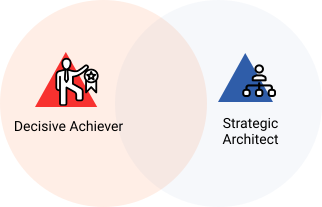
Decisive Achiever + Strategic Architect: pairing this combination can produce vision that ships, when each side cedes ground in their weaker domain.
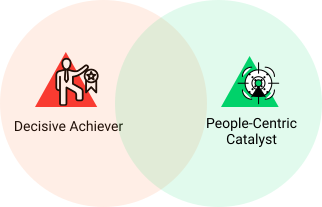
Decisive Achiever + People-Centric Catalyst: directive action stays sustainable when paired with someone who tracks the people cost of the pace.
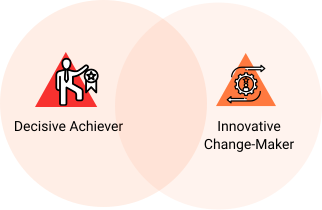
Decisive Achiever + Innovative Change-Maker: creative ideas turn into shipped moves when a decisive partner is willing to commit to one of them.
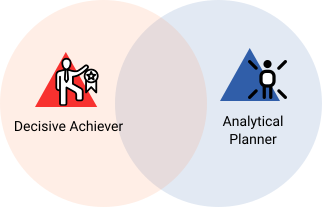
Decisive Achiever + Analytical Planner: analysis converts into action when the decisive partner sets the deadline that forces the call.
When teams understand each persona's value, differences become complementary. Your decisive execution provides the action orientation that prevents others' strategic thinking, people focus, or creative ideas from remaining only conversations.
In closing
The Decisive Achiever isn't a leadership style to celebrate or correct. It's one of 20 patterns SynapseScope models. The fit between the pattern and the role — and the operators around the leader — determines whether the value compounds or the team burns out. Read about all 20 personas →
References & Sources
Research Foundations
- Balasubramanian, S., & Fernandes, C. (2022). Confirmation of a crisis leadership model and its effectiveness: Lessons from the COVID-19 pandemic. Cogent Business & Management, 9(1), 2022824. Cited for: Research identifying decisiveness as one of seven key constructs of effective crisis leadership, emphasizing that time-urgent crises require leaders who can take quick and decisive action with limited information.
- Bhaduri, R. M. (2019). Leveraging culture and leadership in crisis management. European Journal of Training and Development, 43(5/6), 554-569. Cited for: Research showing decisiveness and adaptiveness show the strongest correlations among crisis leadership competencies, particularly in maintaining team morale and organizational agility during time-sensitive situations.
- Journalism University. (2024). Johnson & Johnson's Tylenol crisis: A lesson in ethical crisis management. Journalism University. Cited for: CEO James Burke's decisive decision to issue nationwide recall of 31 million Tylenol bottles worth $100 million within days of the 1982 crisis, prioritizing consumer safety over cost.
- Polpeo. (2024). Tylenol's 1982 recall and lessons in leadership from Johnson & Johnson. Polpeo. Cited for: Details of the Tylenol crisis response setting the gold standard for crisis management through decisive action, with Burke making the call within days to recall 31 million bottles nationwide despite the financial impact.
- Frock, R. (2006). Changing How the World Does Business: FedEx's Incredible Journey to Success — The Inside Story. Berrett-Koehler Publishers. Cited for: Founding-executive account documenting Fred Smith's Las Vegas blackjack episode — taking FedEx's last $5,000 and returning with $27,000 to cover a $24,000 fuel bill — keeping the company solvent for one more week during its early-1970s cash crisis.
- Markel, H. (2014). The Tylenol murders, 1982. PBS NewsHour. Cited for: Documentation that Johnson & Johnson reintroduced Tylenol capsules in November 1982 in a new triple-sealed (tamper-evident) package coupled with heavy price promotions, with the relaunch (not the recall alone) supporting brand recovery.
- Love, J. F. (1995). McDonald's: Behind the Arches. Bantam Books. Cited for: Operational systems with clear standards, structured training, and directive quality controls under Ray Kroc that enabled consistent operations across thousands of locations.
- Welch, J., & Byrne, J. A. (2001). Jack: Straight from the Gut. Warner Books. Cited for: Welch's #1-or-#2 strategic doctrine at GE — the directive that GE business units had to be number one or number two in their industries or exit them — and the rapid-execution / accountability culture that accompanied it.
- Gelles, D. (2022). The Man Who Broke Capitalism: How Jack Welch Gutted the Heartland and Crushed the Soul of Corporate America—and How to Undo His Legacy. Simon & Schuster. Cited for: Documentation of the longer-run costs of the Welch model at GE — talent burnout from rank-and-yank policies, short-term financial-performance pressure, and financialization that shifted GE from manufacturing toward an unregulated-bank profile.
- Nooyi, I. (2021). My Life in Full: Work, Family, and Our Future. Portfolio. Cited for: Indra Nooyi's October 2006 launch of "Performance with Purpose" as PepsiCo's long-term portfolio strategy; her twelve-year CEO tenure (2006-August 2018); PepsiCo's annual net profit growth from $2.7 billion to $6.5 billion during her tenure as a strategic leader.
Case Examples Referenced
- FedEx Operational Crisis Management: Frock, R. (2006). Changing How the World Does Business: FedEx's Incredible Journey to Success — The Inside Story. Berrett-Koehler Publishers. Founding-executive account documenting Fred Smith's decisive operational decisions during early company crises, including the 1973 Las Vegas blackjack episode that bridged a fuel-payment shortfall.
- Johnson & Johnson Tylenol Crisis (1982): Burke, J. (1982). Crisis management response. National recall of 31 million bottles, $100 million cost, within days of tampering deaths. Set gold standard for decisive crisis leadership.
- McDonald's Global Scaling: Love, J. F. (1995). McDonald's: Behind the Arches. Bantam Books. Operational systems with clear standards, structured training, and directive quality controls ensuring consistency across thousands of locations.
- General Electric under Jack Welch: Welch, J., & Byrne, J. A. (2001). Jack: Straight from the Gut. Warner Books. Decisive strategic calls (#1 or #2 in every market or exit), rapid execution, and accountability for results.
Assessment Methodology
SynapseScope Leadership Assessment measures behavioral patterns across 8 dimensions using validated psychometric principles. Decisive Achievers represent a distinctive profile combining high execution focus with high directive orientation and strong goal orientation. For technical documentation, see the science behind the assessment.
Discover Your Leadership Persona
Every organization needs all 20 leadership personas to thrive. Decisive Achievers are just one piece — essential, but incomplete without the others.
Where do you fit in your organization's leadership ecosystem?