
This page is about the Customer Advocate: the leader who builds dual loyalty by treating customer satisfaction and employee well-being as one interdependent system, not competing priorities. See all 20 personas →
About SynapseScope's framework
SynapseScope's leadership personas are proprietary behavioral archetypes, grounded in behavioral psychology and validated against assessment data from thousands of leaders. The framework identifies 20 distinct archetypes. Each one names the pattern that emerges when behavioral tendencies across eight dimensions combine into a recognizable leadership signature.
George W. Jenkins opened the first Publix supermarket in Winter Haven, Florida on September 6, 1930. Decades later, when he stepped back from the company, he sold it to the people who worked there[12]. Today Publix is owned almost entirely by its roughly 260,000 employees and the Jenkins family. Every cashier, baker, and stocker is also a part-owner of the chain.
Publix runs 1,432 stores across the Southeast and reported $4.73 billion in 2025 net income[12]. It is consistently among the highest-rated grocers in U.S. customer-satisfaction surveys. The company is privately held; you cannot buy a share unless you work there.
What makes Publix work is structural rather than philosophical. Customers are served by people who own the place. Employee well-being and customer satisfaction are not competing line items in a manager's quarterly review; they are the same number, distributed across the people inside the store. Most service businesses build the customer-versus-employee trade-off into their org chart. Publix removed it from the cap table.
These are Customer Advocates: leaders who treat customer satisfaction and employee well-being as interdependent. Based on SynapseScope's leadership database (December 2025), Customer Advocates represent a small minority of assessed leaders. These leaders combine deep customer focus with high empathy, responsive agility with empowering growth. They build trust-based relationships on both sides of the business, and create loyalty that survives the kind of price war or service incident that breaks weaker brands.
The question is: Do you have someone building this kind of dual loyalty, and are you that person?
The Psychological Profile of a Customer Advocate
Customer Advocates often feel torn in organizations that force trade-offs. If you're one, you've pushed back when leaders demand you choose between customer satisfaction and employee well-being, immediate response and long-term planning, empowerment and accountability. You refuse the choice because the best outcomes require all of them.
Behaviorally, the Customer Advocate combines four traits: deep customer focus, high empathy, responsive agility, and empowering growth. The integration is what's distinct: customers and employees seen as interconnected, quick response paired with thoughtful planning. The leader reads what customers need before they articulate it, and builds team conditions that let employees deliver without permission slips. Where most leaders optimize for either customer metrics or employee satisfaction, you optimize for both, building lasting loyalty through people who feel valued and supported.
Research on service excellence shows that organizations with the strongest customer loyalty also have the highest employee engagement, and one looks like it produces the other rather than the two just happening together[1][2]. Gallup pooled the results of 736 separate studies covering 347 organizations and compared the most-engaged business units against the least-engaged ones: the most-engaged units delivered roughly 10% more customer loyalty and 23% more profitability[1]. Customers feel genuine care because employees genuinely care.
You read both sides of an interaction at once: customers wanting to feel heard, employees wanting to feel trusted. The known bias of the persona is overweighting whichever side is currently in the room.
Why Every Leadership Team Needs This Perspective
Two failure modes recur in service businesses. Uber under Travis Kalanick drove customer growth through driver and employee burnout[6]. Some companies go the other direction and build a pleasant culture that doesn't ship results to customers. Both modes are real, and both end the same way.
When external customer focus and internal employee well-being get separated, organizations optimize one at the expense of the other.
Customer Advocates build lasting customer loyalty through empowered teams when paired with leaders who hold the financial line. Without that pairing, the loyalty comes at unsustainable cost.
The Unique Value You Bring
Reinforcing systems, not trade-offs.
When Zappos built legendary customer service under Tony Hsieh's leadership, Customer Advocates refused the trade-off and empowered call center representatives to make any decision that served customers well, without managerial approval or rigid scripts[3][4]. Hsieh firmly believed that happy employees lead to happy customers[4]. That simultaneous focus on customer delight and employee autonomy built a brand defined by service excellence.
Relationships outlive metrics.
Nordstrom's service reputation was built neither on rigid processes nor pure empowerment. Customer Advocates built trust-based client relationships by giving employees the judgment and support to solve problems responsively[7]. The mechanism is plausible at scale: empowered employees produce care customers can feel[5].
Situations Where Customer Advocates Become Indispensable
1. Service-Driven Businesses and Customer Experience
Organizations where customer relationships drive competitive advantage need Customer Advocates leading service teams. You build culture instead of mandating it. That works in service-driven businesses with multi-year horizons; it underperforms in turnaround situations needing immediate behavior change.
Real impact: Southwest Airlines' culture is one of several factors people credit for its loyalty premium; operational discipline (point-to-point routing, single fleet type) and fuel hedging are commonly credited as well[8]. Customer Advocates created a culture where employees felt valued and empowered to take care of passengers, which built loyalty that held through price competition and service disruptions[8].
2. Customer Retention and Relationship Building
Organizations struggling with churn need Customer Advocates who build lasting client relationships through responsive, personalized service. The work is empowering teams to address needs quickly, not just closing tickets.
Consider this: Costco's high membership renewal rates rest on a foundation of treating employees well (high wages, benefits), which produces engaged teams who treat customers well[9]. The cycle holds because Costco sells huge volume on a small product range, and the margin from that scale pays for the wage bill[9]. A retailer with a wider catalog and lower volume per item couldn't run the same playbook.
3. Service Recovery and Crisis Management
When customer issues escalate or service fails, organizations need Customer Advocates who respond with empowered teams. Procedures get followed, but the recovery itself depends on people making things genuinely right.
Real impact: Wegmans food markets built strong customer loyalty by giving employees decision-making authority and supporting them to solve problems creatively[10]. The link between that empowerment and the loyalty is plausible, and the company's consistent top rankings point to it[10].
4. Building Customer-Centric Culture
Organizations transforming toward customer-centricity need Customer Advocates who build it through people, not just processes. The culture has to make employees feel valued and empowered, or the customer focus stays at the slide-deck level.
Patagonia's brand loyalty comes from Customer Advocates who built culture focused on both customer relationships (generous returns, environmental alignment) and employee well-being (benefits, autonomy, purpose)[11]. Customers feel the authenticity because it's how the culture operates.
When This Persona Goes Wrong
Without balance from other personas (particularly Results-Driven Executors, Structured Strategists, or Analytical Planners who track the numbers, enforce the process, and read the data), Customer Advocates can prioritize relationships so heavily that business results suffer. When everyone has authority but no one owns the result, accountability blurs; when the team keeps reacting to today's customer, the systems that would let the company serve ten times as many customers never get built; and when present needs absorb every hour, the next strategic move never gets started.
Empathy can become avoidance: performance conversations get postponed, planning loses to reaction, and personal loyalty makes hard calls feel like betrayal. Sometimes the answer isn't more empowerment or responsiveness; it's establishing clear expectations, holding people accountable, or making difficult calls that serve long-term success over short-term comfort.
If you're reading this and thinking "but customers and employees DO deserve genuine care," that reaction itself can be the warning sign. The best Customer Advocates can name the cases where empowering responsiveness prevents accountability, where relationship focus enables underperformance, and where quick response prevents strategic improvement. If colleagues call you soft, ask whether you've made a hard staffing call in the last six months. If not, the criticism may be carrying real weight.
Creating Collaboration, Not Clash
Understanding how Customer Advocates work with others transforms friction into breakthrough:
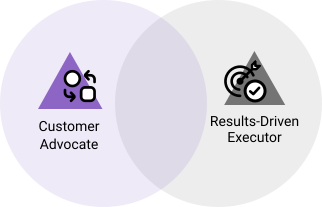
Customer Advocate + Results-Driven Executor: Customer loyalty with business results. Relationship focus balanced by metrics discipline.
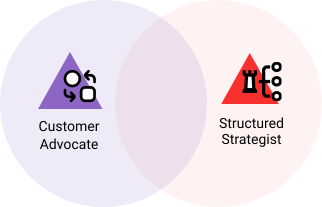
Customer Advocate + Structured Strategist: Exceptional service delivered reliably. Empowered care within scalable systems.
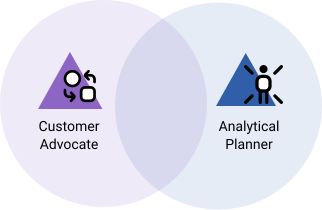
Customer Advocate + Analytical Planner: Data-informed customer experience. Relationship insights quantified and optimized.
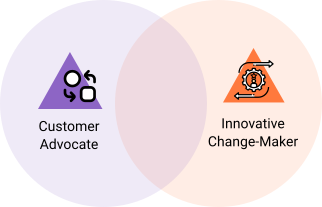
Customer Advocate + Innovative Change-Maker: Service innovation that delights. Bold customer experience ideas grounded in empathy.
In closing
The Customer Advocate isn't a leadership style to celebrate or correct. It's one of 20 patterns SynapseScope models. The fit between the pattern and the role — and the operators around the leader — determines whether the value compounds or the team burns out. Read about all 20 personas →
References & Sources
Research Foundations
- Kemp, A. (2024). The Relationship Between Engagement at Work and Organizational Outcomes: 2024 Q12 Meta-Analysis (11th Edition). Gallup. Cited for: Median percent differences between top-quartile and bottom-quartile business units on employee engagement — roughly 10% in customer loyalty/engagement and 23% in profitability — across 736 research studies in 347 organizations.
- Kumar, V., & Pansari, A. (2016). Competitive advantage through engagement. Journal of Marketing Research, 53(4), 497-514. Cited for: Research demonstrating organizations with strongest customer loyalty also have highest employee engagement as cause and effect relationship.
- Hsieh, T. (2010). Delivering Happiness: A Path to Profits, Passion, and Purpose. Grand Central Publishing. Cited for: Zappos' employee empowerment philosophy where call center representatives make decisions without managerial approval or rigid scripts to serve customers.
- Tjan, A. K. (2010, July 14). Four lessons on culture and customer service from Zappos CEO, Tony Hsieh. Harvard Business Review. Cited for: Tony Hsieh's core belief that happy employees lead to happy customers, creating legendary service culture at Zappos.
- KPMG International. (2024). Beyond the noise: Orchestrating AI-driven customer excellence — Global Customer Experience Excellence Report 2024-2025. KPMG International. Cited for: Research across 86,073 customer interviews and 2,970 brands in 23 countries showing that the best customer experiences come from responsive, empowered teams able to resolve needs immediately, aligned to KPMG's six experience pillars (including Resolution and Empathy).
Case Examples Referenced
- Zappos Customer Service Excellence: Hsieh, T. (2010). Delivering Happiness: A Path to Profits, Passion, and Purpose. Grand Central Publishing.
- Uber Under Travis Kalanick: Isaac, M. (2019). Super Pumped: The Battle for Uber. W. W. Norton. Cited for: documentation of the workplace culture under Kalanick that produced sustained driver and employee strain alongside rapid customer growth.
- Nordstrom Service Culture: Spector, R., & McCarthy, P. D. (2012). The Nordstrom Way to Customer Experience Excellence. John Wiley & Sons. Cited for: Nordstrom's trust-based service reputation built on employee judgment rather than rigid scripts or pure empowerment.
- Southwest Airlines Culture: Gittell, J. H. (2003). The Southwest Airlines Way: Using the Power of Relationships to Achieve High Performance. McGraw-Hill. Cited for: Southwest's cultural and operational drivers (point-to-point routing, single fleet type, fuel hedging, employee empowerment) that produced loyalty resilient to fare wars and service disruptions.
- Costco Employee Treatment: Ton, Z. (2014). The Good Jobs Strategy: How the Smartest Companies Invest in Employees to Lower Costs and Boost Profits. Houghton Mifflin Harcourt. Cited for: the Costco model of high wages and benefits producing engaged teams who serve members well, sustained by high-volume, low-SKU economics that absorb the wage premium.
- Wegmans Customer Loyalty: Fortune Magazine's "100 Best Companies to Work For" (2005-2025). Cited for: Wegmans' consistent top rankings as evidence of an employee-empowerment culture associated with strong customer loyalty.
- Patagonia Purpose-Driven Culture: Chouinard, Y. (2016). Let My People Go Surfing: The Education of a Reluctant Businessman. Penguin Books. Cited for: Patagonia's culture combining customer-facing policies (generous returns, environmental alignment) with employee well-being (benefits, autonomy, purpose).
- Publix Super Markets: Publix Super Markets, Inc. (2025). Company Information & Annual Reporting. Publix Corporate. Founding date and history corroborated by Publix's official corporate timeline; financial figures (2025 net income, store count, employee headcount) drawn from Publix's annual reporting and Wikipedia summary of public filings. Cited for: Publix's 1930 founding by George W. Jenkins in Winter Haven, FL; majority employee ownership (with the Jenkins family retaining roughly 20%); ~260,000 employees as of mid-2025; 1,432 stores across the U.S. Southeast as of August 2025; reported 2025 net income of $4.73 billion; consistent top-tier rankings in U.S. grocery customer-satisfaction surveys.
Assessment Methodology
SynapseScope Leadership Assessment measures behavioral patterns across 8 dimensions using validated psychometric principles. Customer Advocates represent a distinctive profile combining deep customer focus with high empathy, responsive agility, and empowering growth orientation. For technical documentation, see the science behind the assessment.
Discover Your Leadership Persona
Every organization needs all 20 leadership personas to thrive. Customer Advocates are one piece. Essential, but incomplete without the others.
Where do you fit in your organization's leadership ecosystem?