

This page is about the Customer-Centric Visionary: the leader who combines deep customer obsession with strategic imagination, anticipating how customer needs will evolve. See all 20 personas →
About SynapseScope's framework
SynapseScope's leadership personas are proprietary behavioral archetypes, grounded in behavioral psychology and validated against assessment data from thousands of leaders. The framework identifies 20 distinct archetypes. Each one names the pattern that emerges when behavioral tendencies across eight dimensions combine into a recognizable leadership signature.
In 2004, Tobias Lütke and two cofounders launched Snowdevil, an online snowboard store. The existing e-commerce platforms were unworkable, so Lütke — a programmer — built one himself. Snowdevil sold a few snowboards. The platform he had built to sell them turned out to be the more valuable product. The team dropped the snowboards and relaunched the platform as Shopify in 2006[9].
Amazon was the established model: control the storefront, control the customer, take a cut of every sale and own the relationship. Shopify did the inverse. Give merchants the infrastructure to run their own storefronts. Let the customer relationship belong to the merchant. Charge for the platform, not the brand. The shift was about who owned the customer relationship, not who had better software.
By 2024, Shopify processed $292.3 billion in gross merchandise volume[9]; roughly 10% of all U.S. e-commerce now runs on the platform. The merchants who built their stores on Shopify kept their customer relationships. Shopify built one of the largest e-commerce companies in the world by deciding not to compete for those relationships at all.
These are Customer-Centric Visionaries: leaders who combine deep customer obsession with strategic imagination, willing to redirect the whole product when the customer signal points to something better. They ask not only what customers want but where the customer relationship itself can sit in the system. They serve today's articulated needs while envisioning tomorrow's transformed experiences, anticipating how customer contexts will evolve and what will matter in futures customers can't yet describe. Based on the SynapseScope leadership database (December 2025), this profile appears in roughly 4-6% of assessed leaders[5]. When paired with operators who can execute, their presence is what separates incremental improvement from category change; without that pairing, they produce expensive prototypes.
The question is whether someone is imagining your customer-driven future, and whether that person is you.
The Psychological Profile of a Customer-Centric Visionary
Customer-Centric Visionaries often feel torn between immediate customer requests and long-term customer vision. If you're one, you've probably experienced the tension of caring deeply about today's customer satisfaction while imagining how customer experiences could change over years. Pure executors find you too speculative. Pure strategists find you too tied to the customer.
From a behavioral psychology perspective, your profile combines three traits:
- High Visionary Orientation (strategic thinking, forward-focused, long-term vision)
- Deep Customer Focus (prioritizes client needs, builds trust-based relationships, customer-first culture)
- Adaptive Flexibility (adjusts approach, maintains structure while remaining responsive)
What makes this combination psychologically distinct is the way customer empathy and strategic imagination operate together: you don't imagine strategic futures abstractly, you envision customer-driven changes. The difference between a Customer-Centric Visionary and a feature-list executor is the visionary thread; an executor builds the requested feature, while the Customer-Centric Visionary builds the experience that makes the request obsolete.
A 2024 Medium essay by D. Luján and a 2026 CustomerThink article both argue that breakthrough customer experiences require empathy paired with imagination, the kind of understanding that lets you anticipate future needs before customers articulate them[1][2]. This is industry commentary, not peer-reviewed research. Organizations achieving empathy at scale balance innovation and empathy, data and intuition, in their customer relationships.
What the commentary misses is the texture of the work. You've watched a quarter's satisfaction scores absorb all the leadership oxygen while the three-year customer trajectory went undiscussed. You've seen organizations build the requested feature and miss the larger opening. You've had your customer-focused vision dismissed as overthinking, as if envisioning customer futures weren't exactly what reshapes industries.
Why Every Leadership Team Needs This Perspective
The Kodak story is often invoked here: an organization deeply attentive to its film customers, building what those customers asked for, while a different customer experience (digital) reshaped the market around it. Whatever the precise internal dynamics, the pattern it points to is recognizable. Organizations that diligently gather feedback, prioritize every request, and build exactly what customers ask for can still be outflanked when competitors reimagine entire customer experiences that make those incremental improvements irrelevant.
The Unique Value You Bring
When others serve customer requests, you envision customer futures.
When Tony Hsieh built Zappos, he wasn't improving online shoe shopping. He was building a service philosophy where the experience itself was the product. The customer-centric vision (free shipping, 365-day returns, legendary service) reshaped e-commerce by redefining what a customer relationship could be[6].
When others optimize current experiences, you imagine different ones.
The customer pain point everyone is fixing incrementally? You're envisioning a reimagined journey where the pain point doesn't exist because the surrounding experience has changed shape. You imagine tomorrow's possibilities while solving today's problems.
Situations Where Customer-Centric Visionaries Become Indispensable
1. Customer Experience Strategy and Transformation
When organizations need to reshape customer experience rather than improve it incrementally, Customer-Centric Visionaries lead. You don't just map current customer journeys; you envision changed futures and design pathways to create them.
Real impact: When Nordstrom maintained its legendary customer service reputation while navigating digital transformation, Customer-Centric Visionaries didn't just add online features. They envisioned seamless omnichannel experiences where customers move fluidly between digital and physical, with relationships and service excellence consistent across all touchpoints[7].
2. Market Creation Through Customer-Driven Innovation
Organizations need Customer-Centric Visionaries when creating new markets or categories. You don't just find market gaps. You imagine a customer experience that doesn't yet exist, then build a market for it.
Consider this: When Trader Joe's entered grocery, they weren't competing on selection or price alone. They envisioned a different customer experience built on curated discovery, friendly expertise, affordable quality, and quirky personality. That customer-centric vision created a category where traditional grocery metrics didn't apply[8].
Trader Joe's behaved as if it had bet on three counter-intuitive reads of unmet customer needs: that shoppers might want curation over selection, everyday affordability over episodic deals, and clerks who could talk to them. The resulting model turned grocery shopping from transaction to experience.
3. Building Customer-First Cultures
Customer-Centric Visionaries create cultures where customer focus isn't a program but an identity. You don't just advocate for customers; you envision organizational models where customer-centricity drives every decision.
Real impact: When Ritz-Carlton empowers every employee to spend up to $2,000 per guest, per incident to solve customer problems without manager approval[3], that's Customer-Centric Visionaries envisioning a culture where customer satisfaction transcends policies. They imagined an organization that trusts employees to serve customers however needed.
4. Navigating Changing Customer Contexts
When customer needs shift, whether through demographic changes, technology adoption, or cultural evolution, Customer-Centric Visionaries anticipate and envision the experiences that follow. You read how customer relationships will evolve and position organizations ahead of the shifts rather than reacting to them.
Southwest Airlines' loyalty record, consistently top of J.D. Power North American airline rankings[4], suggests they bet on what customers would value rather than what they requested: reliable, affordable, friendly travel where the experience felt refreshingly human in an increasingly automated industry.
When This Persona Goes Wrong
The same imagination that makes you valuable can produce experiences with no operational floor.
Without balance from other personas, particularly Results-Driven Executors, Analytical Planners, or Process-Centric leaders who maintain operational discipline and financial rigor, Customer-Centric Visionaries can envision beautiful customer experiences that aren't economically sustainable. The risk multiplies when customer focus becomes customer indulgence: experiences customized so heavily they can't scale, satisfaction prioritized so absolutely that financial sustainability gets ignored, flexibility so generous that employees lack clarity about standards. Sometimes the right move isn't reimagining the customer experience; it's executing the current one profitably and consistently.
Perhaps most critically: if you can't integrate perspectives from those who balance customer vision with operational excellence, financial discipline, and strategic coherence beyond just customer needs, you become the person who creates exceptional customer experiences that don't translate to sustainable business models, or who serves customers so obsessively that organizational health suffers.
If you're reading this and thinking "but customers ARE the business," that might be the warning sign. Sustainable customer-centricity requires operational viability and attention to employees and shareholders, not just experience design.
Creating Collaboration, Not Clash
Understanding how Customer-Centric Visionaries work with others turns friction into breakthrough:
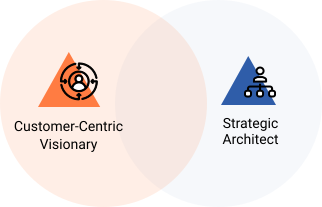
Customer-Centric Visionary + Strategic Architect = Customer-driven strategic vision with execution roadmaps; experiences that can be built systematically.
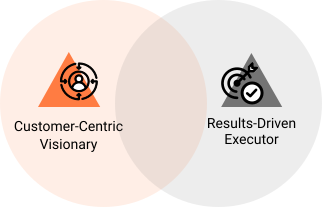
Customer-Centric Visionary + Results-Driven Executor = Exceptional customer experiences delivered consistently; vision balanced with operational excellence.
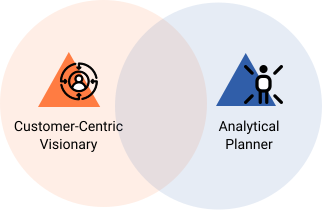
Customer-Centric Visionary + Analytical Planner = Customer vision informed by rigorous data; empathy grounded in evidence.
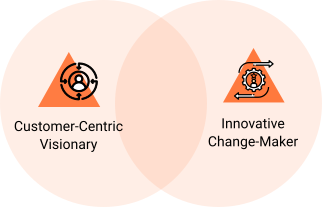
Customer-Centric Visionary + Innovative Change-Maker = Bold customer experience innovation; imaginative thinking applied to customer relationships.
In closing
The Customer-Centric Visionary isn't a leadership style to celebrate or correct. It's one of 20 patterns SynapseScope models. The fit between the pattern and the role — and the operators around the leader — determines whether the value compounds or the team burns out. Read about all 20 personas →
References & Sources
Research Foundations
- Luján, D. (2024). Innovation through empathy: A guide to customer-centric innovation. Medium. Cited for: Research showing breakthrough customer experiences come from combining deep empathy with visionary thinking to understand customer future needs before articulation.
- CustomerThink Research. (2026). How empathy at scale will redefine CRM & customer experience. CustomerThink. Cited for: Research demonstrating organizations achieving empathy at scale balance innovation and empathy, data and intuition, to create transformational customer relationships rather than just mass communication.
- Hyken, S. (2021). An empowerment lesson from the Ritz-Carlton. hyken.com. Retrieved from https://hyken.com/customer-experience/an-empowerment-lesson-from-the-ritz-carlton/ Cited for: Ritz-Carlton's $2,000 per guest, per incident employee empowerment policy.
- J.D. Power. (n.d.). North America Airline Satisfaction Study. J.D. Power. Cited for: Southwest Airlines' consistent top rankings in J.D. Power North American airline customer-satisfaction studies, used as evidence of sustained customer loyalty.
- SynapseScope Leadership Assessment Database. (2025, December snapshot). Internal methodology and prevalence statistics. See also the science behind the assessment. Cited for: 4–6% prevalence figure for the Customer-Centric Visionary persona among assessed leaders; figure derived from SynapseScope's internal assessment database, not externally peer-reviewed.
- Hsieh, T. (2010). Delivering Happiness: A Path to Profits, Passion, and Purpose. Grand Central Publishing. Cited for: Tony Hsieh's articulation of Zappos' service-as-product philosophy, including free shipping and a 365-day return policy as core customer-experience commitments.
- Howland, D. (2020, August 3). What the pandemic has done to Nordstrom's revamp. Retail Dive. Retrieved from https://www.retaildive.com/news/what-the-pandemic-has-done-to-nordstroms-revamp/582635/ Cited for: Nordstrom's coordinated omnichannel ecosystem (full-line stores, Rack, Local, and e-commerce) and the role of Local-format stores in nurturing digital-customer relationships across banners.
- Lewis, L. (2005). Trader Joe's Adventure: Turning a Unique Approach to Business Into a Retail and Cultural Phenomenon. Dearborn Trade. Cited for: Trader Joe's customer-centric model built on curated selection, affordable everyday pricing, friendly knowledgeable staff, and a distinctive brand personality that created a new grocery-experience category.
- Shopify Inc. (2025). Annual Report 2024 (Form 40-F). Shopify Investor Relations. Cited for: Shopify's 2004 origin as Snowdevil, 2006 platform relaunch under Tobias Lütke and cofounders, $292.3 billion in 2024 gross merchandise volume, and ~10% share of U.S. e-commerce processed through the platform.
Case Examples Referenced
- Zappos Customer-Centric Philosophy: Hsieh, T. (2010). Delivering Happiness: A Path to Profits, Passion, and Purpose. Grand Central Publishing. Tony Hsieh's vision of service excellence as the product itself, transforming e-commerce through free shipping, 365-day returns, and legendary service.
- Nordstrom Omnichannel Transformation: Howland, D. (2020, August 3). What the pandemic has done to Nordstrom's revamp. Retail Dive. Retrieved from https://www.retaildive.com/news/what-the-pandemic-has-done-to-nordstroms-revamp/582635/ — documents Nordstrom's market-strategy ecosystem of full-line stores, Rack, Local, and e-commerce; pre-pandemic order-pickup sales up 100%+ and 160% in Local-store markets, with Local stores designed to nurture digital-customer relationships across banners.
- Trader Joe's Category Creation: Lewis, L. (2005). Trader Joe's Adventure: Turning a Unique Approach to Business Into a Retail and Cultural Phenomenon. Dearborn Trade. Customer-centric vision creating curated discovery, friendly expertise, affordable quality, and quirky personality.
- Ritz-Carlton Service Culture: Michelli, J. A. (2008). The New Gold Standard: 5 Leadership Principles for Creating a Legendary Customer Experience Courtesy of the Ritz-Carlton Hotel Company. McGraw-Hill. Customer-first culture with $2,000 employee empowerment policy.
- Southwest Airlines Human-Centered Travel: Freiberg, K., & Freiberg, J. (1996). Nuts! Southwest Airlines' Crazy Recipe for Business and Personal Success. Broadway Books. Vision of reliable, affordable, friendly travel maintaining human experience in automated industry.
Assessment Methodology
SynapseScope Leadership Assessment measures behavioral patterns across 8 dimensions using validated psychometric principles. Customer-Centric Visionaries represent a distinctive synthesis combining high visionary orientation with deep customer focus and adaptive flexibility. For technical documentation, see the science behind the assessment.
Discover Your Leadership Persona
Every organization needs all 20 leadership personas to thrive. Customer-Centric Visionaries are just one piece — essential, but incomplete without the others.
Where do you fit in your organization's leadership ecosystem?