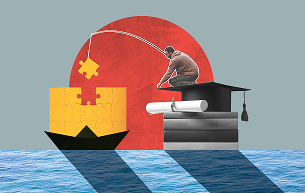

This page is about the Innovative Collaborator: the leader who unlocks breakthrough innovation by facilitating creative collaboration across diverse teams. See all 20 personas →
About SynapseScope's framework
SynapseScope's leadership personas are proprietary behavioral archetypes, grounded in behavioral psychology and validated against assessment data from thousands of leaders. The framework identifies 20 distinct archetypes. Each one names the pattern that emerges when behavioral tendencies across eight dimensions combine into a recognizable leadership signature.
Xerox PARC invented the graphical user interface, the mouse, ethernet networking, and object-oriented programming in the 1970s[1]. Xerox couldn't commercialize any of it. Apple and Microsoft built the GUI businesses Xerox didn't, while Xerox remained a copier company.
Xerox tried structural fixes: better technology transfer processes, clearer IP protection, more funding for research. The problem wasn't structural. It was human. PARC's researchers worked in isolation from business units[1], with no cross-functional collaboration connecting technical innovation with market needs and no facilitated environments where engineers, designers, marketers, and business strategists could create together. Individual genius produced innovations that died in the lab.
Meanwhile, Pixar built a different model. The 'Braintrust' brings together directors, writers, and producers from different projects to review each other's work in psychologically safe sessions where candid feedback improves ideas collectively[2]. Pixar's films come from collaborative teams rather than individual auteurs, and every film is refined through this facilitated process. The difference is collaborative innovation capability, not individual talent.
These are Innovative Collaborators: leaders who unlock breakthrough innovation by facilitating creative collaboration across diverse teams. They combine imaginative creativity with people focus and growth empowerment, and they build the psychological safety that lets teams innovate collectively rather than individually. Based on SynapseScope's December 2025 sample, roughly 5–7% of assessed leaders fit this profile[7], and when paired with execution-disciplined partners they shift innovation output from what one person produces to what a team produces.
The question is whether you have someone who unlocks collaborative innovation, and whether you are that person.
The Psychological Profile of an Innovative Collaborator
If you fit this profile, you're highly creative yourself but you tend to redirect "who should own this?" questions toward "who should be in the room?" Solo-genius cultures register to you as a missed opportunity rather than an aspiration.
From a behavioral psychology perspective, four traits run together:
- High Creative Drive (imaginative, innovative, thinks outside conventional boundaries)
- Intense People Focus (empathetic, relationship-centered, builds trust and collaboration)
- Growth Orientation (predominantly growth-focused, balances empowerment with structure)
- Adaptive Flexibility (adjusts approach, incorporates reliable practices while remaining agile)
What makes the combination distinct is the second trait. You unlock ideas in others rather than generating them alone; your contribution is the room, not the output. The work isn't traditional team management but creative facilitation that turns individual creativity into something the team produces together.
Your attention in an innovation challenge is on the design of the collaborative experience itself: who should be in the room, what level of psychological safety the problem requires, how to keep a session in build-on mode rather than compete mode, how to synthesize diverse perspectives into a coherent direction without flattening any of them.
What separates this from lone-genius creativity is the people-focused thread: a lone genius produces ideas in isolation; the Innovative Collaborator produces ideas through the room.
Observation from leadership work: diverse perspectives, psychological safety, and skilled facilitation tend to unlock creative combinations individuals working alone cannot access. Large-scale bibliometric analysis of nearly 20 million papers and 2 million patents finds that team-authored work has come to dominate the production of high-impact knowledge across the sciences, social sciences, and patents alike[5], and the team-learning and psychological-safety literature converges on the same picture[6].
Why Every Leadership Team Needs This Perspective
Xerox PARC was an organization that hired the most creative individuals, seated them in separate buildings from the business units, and expected breakthrough innovation from isolated effort. The inventions came; the commercialization didn't.
Many organizations celebrate individual creativity without building the psychological safety, facilitation skills, and collaborative practices that turn creative people into collective output. When given authority over team composition and time for facilitated process, Innovative Collaborators unlock collaborative innovation that individual contributors cannot reach alone.
The Unique Value You Bring
When others assign innovation to individuals, you facilitate collaborative breakthroughs.
Pixar doesn't rely on one creative genius. The "Braintrust" is a structured collaborative process where diverse perspectives challenge and improve each other's ideas in psychologically safe settings[2]. That is Innovative Collaborators at work, unlocking collective creativity that surpasses what any single person on the project could produce alone.
When others see competition, you design creative synthesis.
Innovations often emerge when diverse ideas build on each other rather than compete, and the rooms you facilitate are where "yes, and..." thinking replaces "yes, but..." criticism. Collaboration amplifies creativity rather than constraining it, on the condition that the problem genuinely benefits from multiple perspectives.
Situations Where Innovative Collaborators Become Indispensable
1. Cross-Functional Innovation and Product Development
When organizations need innovation that combines diverse expertise across technology, design, business, and customer insight, Innovative Collaborators facilitate the work. The contribution is not coordination of functions but creative synthesis drawn out of their combination.
Real impact: IDEO's pioneering of design thinking didn't stop at hiring creative designers. The firm built collaborative methodologies where diverse teams (engineers, anthropologists, designers, business strategists) innovate together through facilitated creative processes[3].
2. Complex Problem-Solving Requiring Diverse Perspectives
When challenges are too complex for single disciplines, Innovative Collaborators bring together diverse minds and facilitate breakthrough solutions. The orchestration combines technical, human, business, and creative perspectives into holistic responses.
Real impact: Wikipedia wasn't built by one brilliant editor. Larry Sanger and Jimmy Wales designed the platform; the editing community wrote the policies that made collaboration safe at scale[4]. The collaborative model produced something traditional team structures rarely achieve.
Wikipedia's collaborative framework reflects design choices that, in practice, lower the bar for new contributors and protect collective work. "Ignore all rules," adopted early in Wikipedia's policy history, has the practical effect of inviting newcomers to contribute without first mastering the rulebook. Talk pages and WikiProjects gave diverse perspectives a place to negotiate. The lack of single-author credit emphasized collective over individual contribution. Edit history preserved every change for iterative improvement, and "Neutral point of view" provided shared ground for editors with different priors[4].
When This Persona Goes Wrong
The greatest strength, overexpressed, becomes the failure mode.
Without balance from Results-Driven Executors, Strategic Architects, or Directive Leaders who carry delivery focus and strategic discipline, Innovative Collaborators facilitate creative collaboration that never ships. The processes become so inclusive that decisions slow to a stall. The emphasis on psychological safety holds back the critical feedback the work actually needs, and the collaborative approach turns into consensus-seeking that dilutes bold ideas down to a comfortable middle.
The deeper failure mode shows up when you cannot integrate perspectives from operators who pair creative collaboration with execution discipline, strategic focus, and performance accountability. Without that integration, you become the leader who creates excellent collaborative experiences that don't translate into shipped innovations, or who facilitates creativity unmoored from strategic purpose.
If you're reading this and thinking "but collaborative innovation IS how breakthroughs happen," that reaction itself is the warning sign. The strongest Innovative Collaborators know when to close collaboration and decide, when to push past safety toward excellence.
Creating Collaboration, Not Clash
Understanding how Innovative Collaborators work with others transforms friction into breakthrough:
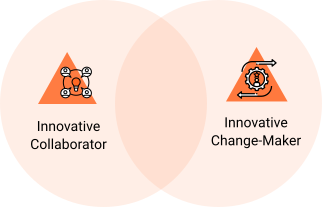
Innovative Collaborator + Innovative Change-Maker = Bold individual creativity amplified through collaborative teams; risk-taking supported by collective innovation.
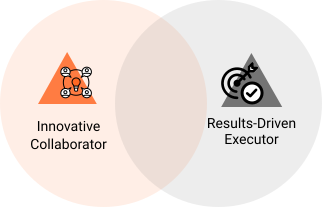
Innovative Collaborator + Results-Driven Executor = Creative collaboration that ships, with innovative ideas translated into delivered products.
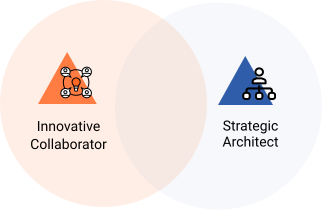
Innovative Collaborator + Strategic Architect = Collaborative innovation aligned with strategic vision; creative teams focused on purposeful outcomes.
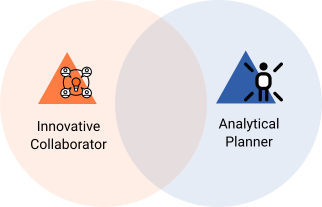
Innovative Collaborator + Analytical Planner = Creative collaboration informed by data and frameworks; imagination grounded in analysis.
In closing
The Innovative Collaborator isn't a leadership style to celebrate or correct. It's one of 20 patterns SynapseScope models. The fit between the pattern and the role — and the operators around the leader — determines whether the value compounds or the team burns out. Read about all 20 personas →
References & Sources
Research Foundations
- Hiltzik, M. (1999). Dealers of Lightning: Xerox PARC and the Dawn of the Computer Age. New York: HarperBusiness. Also documented in Smith, D. K., & Alexander, R. C. (1988). Fumbling the Future: How Xerox Invented, Then Ignored, the First Personal Computer. New York: William Morrow. Cited for: Xerox PARC's groundbreaking inventions (GUI, mouse, ethernet, object-oriented programming) in the 1970s and the failure to commercialize them due to lack of cross-functional collaboration between research and business units, resulting in hundreds of billions in lost market value.
- Catmull, E., & Wallace, A. (2014). Creativity, Inc.: Overcoming the Unseen Forces That Stand in the Way of True Inspiration. New York: Random House. Cited for: Pixar's "Braintrust" collaborative process where directors, writers, and producers from different projects review each other's work in psychologically safe sessions, enabling candid feedback that improves films collectively through diverse creative perspectives rather than individual auteur vision.
- Kelley, T., & Littman, J. (2001). The Art of Innovation: Lessons in Creativity from IDEO, America's Leading Design Firm. New York: Currency/Doubleday. Also Brown, T. (2009). Change by Design: How Design Thinking Transforms Organizations and Inspires Innovation. New York: Harper Business. Cited for: IDEO's pioneering of design thinking collaborative methodologies where diverse teams (engineers, anthropologists, designers, business strategists) innovate together through facilitated creative processes, producing innovations individual disciplines couldn't achieve alone.
- Reagle, J. (2010). Good Faith Collaboration: The Culture of Wikipedia. Cambridge: MIT Press. Also Lih, A. (2009). The Wikipedia Revolution. New York: Hyperion. Cited for: Wikipedia's collaborative innovation framework including "Ignore all rules" for psychological safety, Talk pages and WikiProjects for diverse perspectives, no single-author credit emphasizing collective contribution, edit history for iterative improvement, and "Neutral point of view" providing neutral ground for collaboration.
- Wuchty, S., Jones, B. F., & Uzzi, B. (2007). The increasing dominance of teams in production of knowledge. Science, 316(5827), 1036–1039. Cited for: bibliometric evidence (drawn from approximately 19.9 million papers across five decades and 2.1 million patents) that team-authored work has come to dominate the production of high-impact knowledge across the sciences, social sciences, arts and humanities, and patents alike.
- Edmondson, A. C. (2018). The Fearless Organization: Creating Psychological Safety in the Workplace for Learning, Innovation, and Growth. Hoboken, NJ: John Wiley & Sons. Cited for: synthesis of the team-learning and psychological-safety research showing that diverse teams operating in psychologically safe environments learn, innovate, and outperform comparable teams without that climate.
- † SynapseScope Leadership Database (December 2025). Proprietary assessment data. For methodology, see the science behind the assessment.
Case Examples Referenced
- Xerox PARC - Used to illustrate the failure of brilliant individual innovation without collaborative infrastructure, showing how isolation between researchers and business units prevented commercialization of breakthrough inventions that competitors later built into empires.
- Pixar Braintrust - Exemplifies successful collaborative innovation through structured psychological safety where diverse creative perspectives challenge and improve ideas collectively, producing films no individual auteur could create alone.
- IDEO Design Thinking - Demonstrates collaborative methodologies that combine diverse disciplines (engineering, anthropology, design, business strategy) through facilitated creative processes to produce breakthrough innovations.
- Wikipedia - Illustrates large-scale collaborative innovation through platform design that enables thousands to create knowledge collectively via policies promoting psychological safety, diverse perspectives, collective credit, and neutral collaboration grounds.
Assessment Methodology
SynapseScope Leadership Assessment identifies Innovative Collaborators through behavioral patterns including high creative drive (imaginative, innovative thinking), intense people focus (empathetic, relationship-centered), growth orientation (empowerment with structure), and adaptive flexibility. Prevalence statistics derived from proprietary database (December 2025). For technical documentation, see the science behind the assessment.
Discover Your Leadership Persona
Every organization needs all 20 leadership personas to thrive. Innovative Collaborators are one essential piece, incomplete without the others.
Where do you fit in your organization's leadership ecosystem?