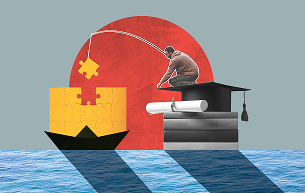

This page is about the Process Innovator: the leader who reimagines processes themselves so that systematic thinking and creativity reinforce rather than cancel each other. See all 20 personas →
About SynapseScope's framework
SynapseScope's leadership personas are proprietary behavioral archetypes, grounded in behavioral psychology and validated against assessment data from thousands of leaders. The framework identifies 20 distinct archetypes. Each one names the pattern that emerges when behavioral tendencies across eight dimensions combine into a recognizable leadership signature.
On October 29, 2018, Lion Air Flight 610 crashed into the Java Sea, killing all 189 people aboard. Five months later, on March 10, 2019, Ethiopian Airlines Flight 302 crashed, killing 157. Both crashes involved Boeing 737 MAX aircraft. The root cause: Boeing's MCAS software system[1].
Boeing faced a genuine innovation challenge: its new 737 MAX had larger engines that changed the aircraft's handling. MCAS was designed to compensate automatically[1].
Boeing's process was optimized for efficiency. The 2020 House Committee report[1] identified the specific failures: MCAS relied on a single angle-of-attack sensor, pilots were not trained on the system, and Boeing's safety analyses understated MCAS authority. Each was a process choice that no one redesigned.
Process Innovators redesign the system itself rather than choosing between creativity and discipline.
The question is whether you have someone who can hold both, and whether that someone is you.
The Psychological Profile of a Process Innovator
Process Innovators tend to be read as too structured by creative teams and too creative by operational ones, which makes both sides slow to recognize what the leader is actually doing.
Behaviorally, this profile combines three patterns most leaders treat as incompatible:
- Process-Centric thinking (systematization, standardization, efficiency)
- Creative orientation (novelty-seeking, experimentation, possibility)
- Flexible adaptation (contextual responsiveness, iterative refinement)
The combination produces a particular working stance. You treat existing process as a canvas for redesign rather than as a fixed condition.
Brain-imaging research finds that creative people show strong communication between the regions that handle focused planning and the regions that handle open-ended, inward thought — connectivity between the executive-control and default-mode networks, which interact when attention turns inward[2][3]. Whether that pattern maps onto the Process Innovator profile is our inference, not a measured finding in the cited papers.
The difference between a Process Innovator and a process optimizer is the creative reframe; an optimizer makes the existing process faster, while a Process Innovator changes what the process is for.
Why Every Leadership Team Needs This Perspective
Process Innovators surface a view that operational and creative teams both miss: the gap between how the work is done today and how the work could be redesigned. Operational leaders track variance against the existing process. Creative leaders generate ideas that sit outside the process. The Process Innovator works on the process surface itself, which is the surface that determines whether either group's contribution actually compounds.
The Unique Value You Bring
Constraints become design problems.
A budget cut, a new regulation, or a bottleneck reads to a Process Innovator as a redesign brief, not a limitation to push back against. The trade-off worth naming: redesign budget can land on constraints that did not actually need solving, which is a real cost when the same hours could have funded a delivery sprint instead.
Creativity becomes a repeatable mechanism.
A Process Innovator builds the scaffolding that turns one-off creative output into a routine the rest of the organization can run. Given authority over process design and a clear scope, the leader can make innovation repeatable. Without that authority, the same instinct produces shadow process that no one adopts.
Situations Where Process Innovators Become Indispensable
1. Digital Transformation Initiative
In a digital transformation, tech teams concentrate on tools and change managers concentrate on people. The work the Process Innovator does sits in the gap between them: redesigning what the daily flow actually looks like once the new system is in place, so that the transformation lands in operations rather than only in the software.
Composite example: an operations leader at a mid-size logistics firm did not stop at rolling out new warehouse software. She rewrote the fulfillment workflow around it, producing a meaningful reduction in processing time while improving accuracy.
2. Scaling Innovation
Pilot programs often struggle to extend beyond the team that ran them, because the pilot ran inside an exception to the standard process. Process Innovators do the unglamorous work of redesigning the standard process itself so that the pilot's behaviors become the default, which is what enterprise implementation actually requires.
3. Regulatory Compliance Meets Innovation
In regulated industries with stable rules and a sponsor willing to fund process redesign, Process Innovators can convert compliance work into a defensible operational advantage by building the controls into the workflow rather than bolting them on. The condition matters; without funded redesign authority, the same instinct produces additional documentation that no one reads.
4. Crisis Response and Adaptation
During disruption, the leader rapidly redesigns operations while keeping the parts that still hold load running.
When This Persona Goes Wrong
The same instinct that makes Process Innovators useful makes them dangerous when nothing checks it.
Without counterweight from other personas, particularly Visionary Innovators who push the scope outward or Structured Strategists who hold the existing structure stable, Process Innovators over-engineer. Overexpressed, the same instinct optimizes processes that did not need optimization and turns frameworks into constraints.
The risk multiplies when process is prioritized over people.
Most critically: if the leader cannot integrate perspectives from peers who balance process innovation with strategic vision, people development, and execution discipline, the output tends to be processes that do not deliver business value, or systems that optimize for the wrong outcomes.
If you are reading this and thinking, "but processes ARE the solution, others just don't appreciate systematic thinking," that may be the warning sign. The best Process Innovators treat processes as a means by which people and strategy succeed, not as the end being served.
Creating Collaboration, Not Clash
Understanding how Process Innovators work with others transforms friction into partnership:
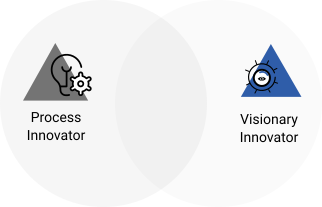
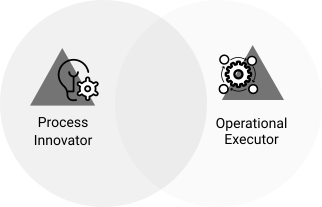
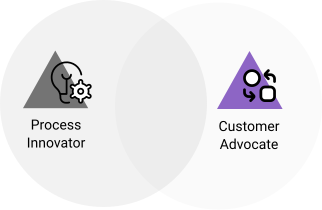
Process Innovators are where big ideas and disciplined delivery meet inside the day-to-day workflow.
In closing
The Process Innovator isn't a leadership style to celebrate or correct. It's one of 20 patterns SynapseScope models. The fit between the pattern and the role — and the operators around the leader — determines whether the value compounds or the team burns out. Read about all 20 personas →
References & Sources
Research Foundations
- Nicas, J., Kitroeff, N., Gelles, D., & Glanz, J. (2019). "Boeing Built Deadly Assumptions Into 737 Max, Blind to a Late Design Change." The New York Times. Also documented in U.S. House Committee on Transportation and Infrastructure (2020). "Final Committee Report: The Design, Development & Certification of the Boeing 737 MAX." Cited for: Boeing 737 MAX crashes (Lion Air Flight 610 on October 29, 2018, killing 189; Ethiopian Airlines Flight 302 on March 10, 2019, killing 157) caused by MCAS software system, illustrating the catastrophic failure when process innovation is absent and optimization for efficiency lacks creative integration to reimagine certification processes for unprecedented software-controlled flight characteristics while maintaining safety rigor.
- Beaty, R. E., et al. (2018). Robust prediction of individual creative ability from brain functional connectivity. PNAS, 115(5), 1087-1092. Cited for: Neuroscience research on creative cognition showing connectivity patterns between brain networks that may correlate with the ability to engage both structured thinking and creative exploration, a hallmark of Process Innovator behavioral profiles.
- Zabelina, D. L., & Andrews-Hanna, J. R. (2016). Dynamic network interactions supporting internally-oriented cognition. Current Opinion in Neurobiology, 40, 86-93. Also Andrews-Hanna, J. R., et al. (2014). The default network and self-generated thought: Component processes, dynamic control, and clinical relevance. Annals of the New York Academy of Sciences, 1316(1), 29-52. Cited for: Research on enhanced connectivity between executive control network (planning, structured thinking) and default mode network (creativity, exploration) that may characterize individuals who can fluidly switch between or engage both modes simultaneously, a cognitive pattern associated with process innovation capabilities.
Case Examples Referenced
- Boeing 737 MAX (2018-2019) - Used to illustrate the catastrophic failure when process innovation is absent from safety-critical systems, where optimization for efficiency without creative integration of new technologies and rigorous process reimagination led to two fatal crashes killing 346 people, demonstrating the vital need for leaders who can bridge creativity and systematic thinking.
- Logistics Company Fulfillment Redesign - Demonstrates process innovation value through complete workflow reimagination (not just software implementation) that reduced processing time 40% while improving accuracy, exemplifying how Process Innovators transform operations by redesigning how work gets done rather than just digitizing existing processes.
Assessment Methodology
SynapseScope Leadership Assessment identifies Process Innovators through behavioral patterns including process-centric thinking (systematization, efficiency orientation), creative orientation (novelty-seeking, experimentation), and flexible adaptation (contextual responsiveness, iterative refinement). For technical documentation, see the science behind the assessment.
Discover Your Leadership Persona
Every organization needs all 20 leadership personas to thrive. Process Innovators are one piece. They are not complete without the others.
Where do you fit in your organization's leadership ecosystem?